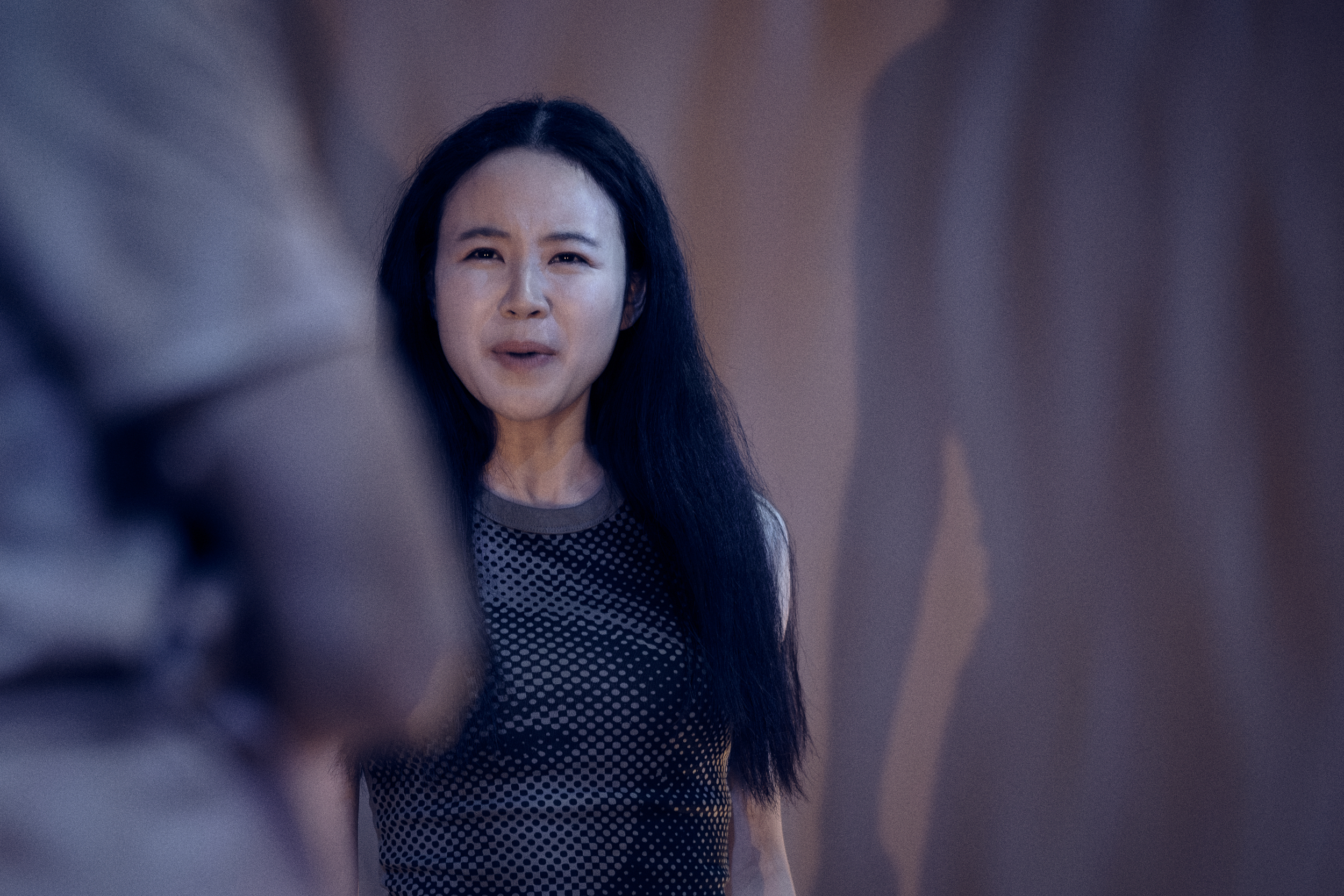
Embodi Theatre has premiered a new bilingual play at PIP Theatre, exploring the intersections of human emotion and artificial intelligence. Written and directed by Amy Chien-Yu Wang, with dramaturgy by Helen Strube, AI May is a bittersweet story of loss and love centred on the tensions between an immigrant mother and her first-generation Australian daughter.
AI May is set in Brisbane 2035, just a decade into the future. When her only daughter, May, is killed in an accident, Mrs Chen loses her daughter and also her sense of identity as a mother. May’s boyfriend, a robotics engineer named Jeremy, channels his energy into building a grief companion – a robot that looks exactly like May – and offers it to Mrs Chen when it fails to relieve his own sense of loss. Isolated, with her husband having died years before, Mrs Chen talks to the robot when she is not working as a Personal Detail Cleaner in wealthy people’s houses, competing with robots for clients and differentiated by the “human touch” of their services.
The robot is pleasant and helpful, but she is not Mrs Chen’s daughter. Mrs Chen begins to move forward once she accepts that May is gone and cannot be replaced or replicated. She also learns to trust Jeremy and his intentions, and to begin to share her grief with him. The play concluded with a heart-rending monologue that drew the entire work together; Mrs Chen recounted a dream she had as if speaking to May, with the impact of the scene elevated by technical design so that she became a silhouette floating in the cosmos.

The potential uses for technology in coping with grief and loneliness have long been fodder for sci-fi and speculative fiction stories, and AI May brings this close to home. Set in Brisbane in 2035, just a decade into the future, the world building is simple and effective and feels entirely plausible. Mrs Chen speaks with AI customer service agents about her housing and medical appointments, which are contrasted against the sophistication of AI May. A merciless social housing system is in place and Mrs Chen is given six months to vacate her home after her daughter dies, since the space is required for a larger number of people. Other elements, like Jeremy’s AI assistant and Mrs Chen’s health-monitoring brooch, are barely removed from current technology.
AI May is a bilingual production, with projected surtitles in both Traditional Chinese and English, although these were occasionally obscured by the actors due to the height of the stage. The storytelling was straightforward, but unfurled layers of unspoken emotion and relationships.
Set and costume design by Bill Haycock, multimedia and sound design by Freddy Komp, and lighting design by Geoff Squires came together beautifully to build the world of AI May, and the soundscape included works by Matt Hsu’s Obscure Orchestra, Becky Suizhen, Mindy Meng Wang, Flora Wong, and Connor D’Netto.
AI May played out on a raised catwalk stage, slicing diagonally across the performance space and divided clearly. While Mrs Chen’s space unfurled like a scroll, Jeremy’s work took place in its own cylindrical pod, with projected code swiped across it and lighting used to represent his voice-only AI assistant. Video projections also depicted Jeremy’s memories of May and embellished the surtitles. Some technical difficulties on opening night necessitated a pause, but the actors remained in place and the play resumed and continued smoothly.

Clarise Ooi played the role of the robot, as well as the human May in the memories of her mother. Ooi created a distinct physicality and facial expressiveness for each version of May and switched seamlessly between these, from the affected movement and pleasant tone of the grief companion to a playful child at the beach and a young woman arguing passionately with her mother. Anna Yen gave a moving performance as Mrs Chen, and AI May incorporated several movement interludes that expressed her pain through butoh and physical theatre.
Justin Ryan played the role of Jeremy with feeling, although the physical and verbal escalation of his argument with Mrs Chen felt disproportionate. Ryan also managed many of the onstage technical elements and interacted with the projections in his “pod” with excellent timing.
Ke Zhen Yi played Mrs Lin, Mrs Chen’s outgoing friend and employer, and provided much of the play’s comic relief in this role. She also played Mrs Chen’s patient and sympathetic doctor, Dr Tung.
Including many interesting movement and multimedia elements, AI May is a layered and ambitious new work that looks ahead to a plausible near-future as it grapples with timeless themes of parenthood, grief, and love.
AI May will be performed at PIP Theatre, Milton, from 17 – 27 October 2024
For further information, visit the PIP Theatre website
 Backstreet Brisbane
Leave a comment