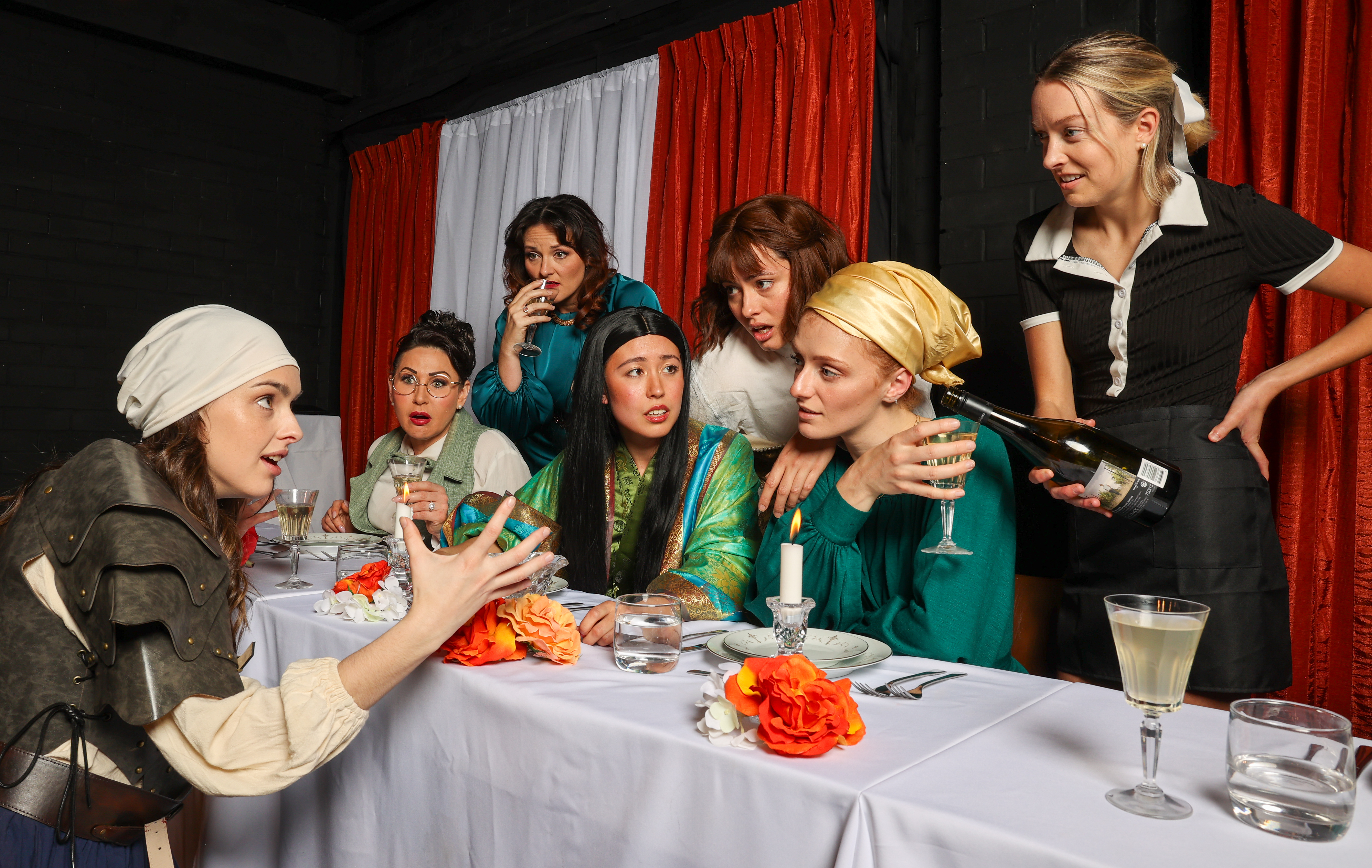
Written by Caryl Churchill and first performed in 1982, Top Girls follows the lead character of Marlene as she strives for success in a male-dominated workplace. Ad Astra’s production is directed by Mikayla Hosking, with assistant direction by Samara Louise, and stars an excellent ensemble of character actors, led by Aurelie Roque as Marlene.
In the first act of the play Marlene, recently promoted to an executive position at the Top Girls employment agency, throws a lavish dinner party with a guest list of historical women through history: Isabella Bird, an explorer and naturalist from the Victorian era; Lady Nijo, a concubine to the Japanese Emperor Go-Fukakusa and later a Buddhist nun; Dull Gret, a figure from Flemish folklore who is depicted leading an army of women to pillage Hell; Pope Joan, a woman who reigned as pope for two years in the Middle Ages, according to legend; and Griselda, a figure of European folklore known for her patience and obedience in her marriage to the Marquis. With her historical guests, Marlene shares stories of marriage, children, love, politics, and religion, foreshadowing key themes that will emerge in her own life as the play progresses.
The play’s action is divided into three distinct parts, following Marlene as the protagonist – the imagined dinner party, the employment agency in the present, and a visit to her sister Joyce’s house in the past – which flow together with impressive cohesion given the non-linear storytelling. This structure also allows for the slow revelation of deeper meanings, from foreshadowing in the dinner party conversation to Angie’s sinister intentions in the second act. Churchill’s overlapping dialogue, particularly in the dinner party scene, heightened the sense of audience immersion, as did the staging in Ad Astra’s black box theatre.

Top Girls is set in England in the late 1970s – Margaret Thatcher is Prime Minister, and the play addresses ideas of individualism versus collectivism and the cost of professional success, ambition, and social mobility for women at that time. Top Girls explores gender roles and the widening horizon of possibility for (some) women under Thatcher, but also the sacrifices required from these women to live on their own terms in a man’s world, and the ways in which they subconsciously or deliberately imitated the patriarchal structures that had previously impeded them.
Top Girls also declaws the capitalist myth of the modern woman who can have it all, particularly in an environment where the success of these women, as “new patriarchs”, relied equally heavily on the unseen labour of other women as the old guard did. Through its modern and historical characters, the play digs into the intersections of class and gender, and the historical trajectory of issues concerning the rights and opportunities of women.
There were parallels between the historical and modern characters, often doubled by the same actor – Angie and Dull Gret both had a clipped or disjointed way of speaking, Lady Nijo and Win were both proud of their status as mistresses, and Marlene and Isabella had left the ‘family life’ to their sisters while pursuing their own ambition in a man’s world.
Costuming designed by Xanthe Jones was outstanding, from Pope Joan’s pontifical robes to the crisp silhouettes of Marlene’s employment agency colleagues. Sound design by Rosie Richardson and lighting design by Claire Yorston reinforced the space and time of each scene, and the real candles on the dinner party table, along with the real food eaten by the actors in these scenes, added to the atmosphere and create further audience immersion. Transitions between set locations were managed smoothly by the cast and crew, with stage management by Lara Rix and Patria Leong.
Aurelie Roque had a commanding stage presence in the lead role of Marlene, embodying the strength and ruthlessness of a career woman focused on her own success at any cost. The six-person ensemble alongside Roque – Natasha McDonald, Jazz Zhao, Anastasia Benham, Brigitte Freeme, Chelsea Doran, and Emmy Moore – all played multiple roles and demonstrated impressive versatility. Chelsea Doran gave an excellent performance, expressive even without dialogue as Dull Gret, and walking a fine line between threatening and endearing as Angie. Natasha McDonald was outstanding as Isabella Bird and Marlene’s sister Joyce, and Moore, McDonald, and Feeme also played roles as women seeking jobs through the Top Girls employment agency.
Top Girls leaves the audience with plenty of things to chew on, thematically, and the sustained energy and emotion throughout the performance at Ad Astra is a testament to the significant skill and commitment of the cast and creative team.
Top Girls will be performed at Ad Astra, Fortitude Valley, from 20 July – 12 August, 2023
For ticketing and further information, visit the Ad Astra website
 Backstreet Brisbane
Leave a comment