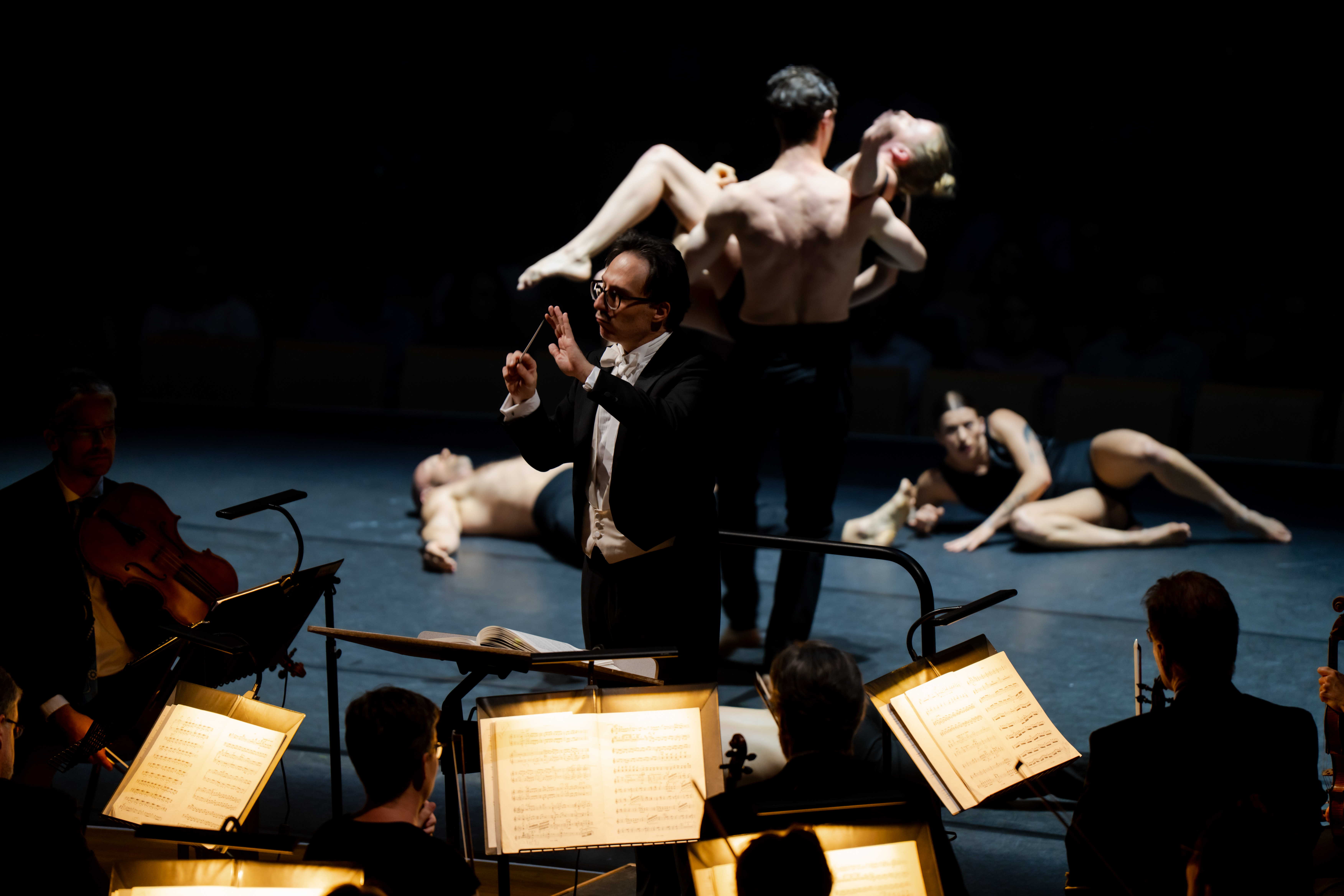
Queensland Symphony Orchestra’s 2025 Season Opening Gala, The Rite of Spring, was an exhilarating start to the year. The concert was conducted by Chief Conductor Umberto Clerici, with the eponymous piece by Stravinsky presented in an exciting collaboration with Circa.
Having explored the Classical and Romantic periods in 2023 and 2024 respectively, Queensland Symphony Orchestra’s 2025 programming will focus on 20th century works. This year marks the conclusion of an interconnected three-year arc under Clerici’s artistic leadership, and the 2025 season will also focus on a philosophical theme of spirituality, following on from themes of humanity and nature in the previous two years.

The audience was welcomed by QSO Chief Executive Officer Michael Sterzinger, who was appointed last November. Sterzinger spoke of the orchestral colours and textures of Debussy’s piece, introduced the first appearance of 2025 QSO Artist in Residence Kristian Winther, who played solo violin in Respighi’s concerto, and explained the reimagined story of Stravinsky’s masterpiece.
The 2025 Season Opening Gala began with Debussy’s Prélude à l’après-midi d’un faune (Prelude to the Afternoon of a Faun), a dreamy piece of music and a gentle, lulling opening to the concert. A tone poem based on Stéphane Mallarmé’s French symbolist poem, Prelude to the Afternoon of a Faun conjures a lush magical forest and paints a brief story of a faun awakening from an afternoon sleep and languorously recalling his encounters with nymphs.

Debussy’s Prelude was followed by Ottorino Respighi’s Concerto Gregoriano, a piece of music with an entirely different energy but equally vibrant imagery. Inspired by the history and music of early Christianity, including Gregorian chanting and plainsong, the violin concert premiered in Rome in 1921.
Although the Circa collaboration was the centrepoint of this concert, I was unexpectedly moved and captivated by the Concerto Gregoriano – the richness of the music, and the oscillation between tension and tenderness. The orchestra was a force of nature with chanting brass and percussion like the rumbling roll of thunder, an ocean of sound rushing out to the audience and surging beneath the nimble swiftness of the solo violin.
Kristian Winther, QSO’s 2025 Artist in Residence, was the soloist for this work and seemed to wrestle and dance with the music, bobbing and weaving or slowing to a sway. The violin called out, evocative of vast landscapes or perhaps the interior of a cathedral, and the orchestra soared around the solo instrument.

Following an interval, during which the stage was adjusted to create a performance space between the orchestra and the audience, the concert resumed with The Rite of Spring. Ten Circa acrobats entered the stage as the orchestra tuned up.
Igor Stravinsky’s masterpiece famously incited an alleged audience riot when it premiered in Paris in 1913, and is one of the most influential musical works of the 20th century and one of the first modernist works. It was written for a ballet choreographed by Nijinsky (whose first, also controversial, choreographic work was for Debussy’s L’après-midi d’un faune). The Rite of Spring received its first concert performance (the music only, without dancers) in 1914.

The work is divided into two parts – Adoration of the Earth, and The Sacrifice. The story of the ballet depicts a series of rituals to mark the coming of spring, including a Ritual of Rival Tribes, Procession of the Sage, and Evocation of the Ancestors, culminating in the Sacrificial Dance of The Chosen One, wherein a young girl dances herself to death.
Queensland Symphony Orchestra and Circa’s The Rite of Spring was so stimulating I immediately wished I could experience it again. The work opens with a bassoon melody derived from an anthology of Lithuanian folk songs, and descends into thrilling, thumping, snarling primitivism. At times, there was a sense that the music was out of control, and yet everything felt perfectly in place. I marvelled at what skill and control of the medium must be required, in both the composition and the performance, to manufacture such thrilling disquiet and chaos.

There was a distinct shift in the lighting design for The Rite of Spring, with the orchestra less visible than the acrobats. Vivid colour was also used, and a suspended ring of lights above the centre of the stage created a criss-cross of spotlights that evoked a maypole, emphasising the sense of ritual and the pagan inspirations of the piece.

Circa CEO and Artistic Director Yaron Lifschitz directed The Rite of Spring. The visual storytelling felt less abstract, and the synchronicity of the acrobats more airtight, than previous Circa performances I have seen. As always, I was in awe of the vigorous energy, explosive power, and breathless balances unfolding onstage. The Circa acrobats performed incredible feats of balance and tumbling with such strength and control that they seemed to tumble in slow motion. There were also sections of the work that veered towards contemporary dance, with the acrobats jolting at invisible impacts and roiling, crawling over one another so that it was difficult to distinguish one body from the next. There was a sense of scurrying in the movement on the ground, and the acrobats made flying leaps, built grotesque silhouettes from their stacked bodies, and carried each other across and above the stage. There were recurring motifs in the movement, especially a particular posture of the arms, that echoed through the whole half hour, and the image of the Sacrificial Dance – one acrobat, alone in the centre of a circle, performing an escalating series of somersaults, kicks, and rolls so that they seemed to thrash in their dance to the death – has stayed with me.

Exhilarating, vivid, and transporting, The Rite of Spring was a notable start to Queensland Symphony Orchestra’s 2025 season and a victorious collaboration with Circa, fellow Brisbane-based masters of their craft.
The Rite of Spring was performed at the QPAC Concert Hall from 20 – 22 February 2025
For further information, visit the Queensland Symphony Orchestra website
 Backstreet Brisbane
Leave a comment