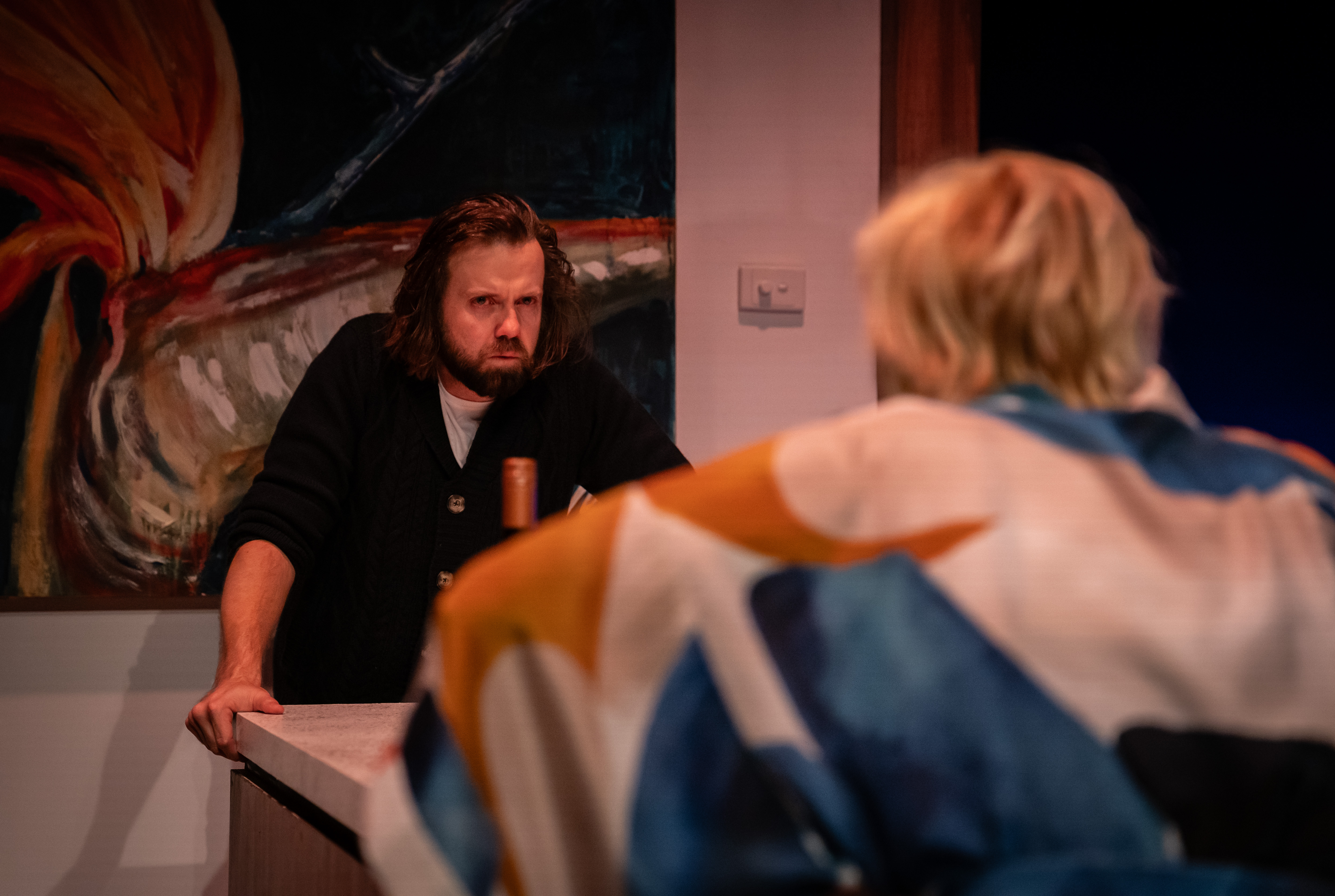
Searing domestic drama The Norman Mailer Anecdote has made its world premiere at Queensland Theatre’s Diane Cilento Studio. The playwrighting debut of award-winning local screenwriter Anthony Mullins, The Norman Mailer Anecdote follows one high-achieving Brisbane family over a night of drinking and dissection after the accusation of an historical sexual assault.
Directed by Julian Curtis, The Norman Mailer Anecdote is the first work to be staged as part of Queensland Theatre’s inaugural DOOR 3 initiative. Named after the entrance to the Diane Cilento Studio, DOOR 3 provides opportunities for Queensland-based theatre collectives to stage independent works in that space.

Ruthlessly ambitious lawyer Helen is preparing to become an equity partner. Her 20-year-old daughter Samantha is on her way out to celebrate a friend’s birthday. Her husband of 25 years, novelist Marshall, arrives home and informs Helen that he can’t attend this important event with her. When Helen returns, triumphant, she learns that Marshall has been accused of an historical sexual assault by an ex-girlfriend from 1992. At the same time, a video from Samantha’s night out is circulating online and she is struggling to control the damage.
As the night stretches on, Helen and Marshall’s egos clash over the kitchen counter. They consult his old diaries as well as his memories, and the statements of earlier scenes take on new meanings and raise new questions. The play criticises Australia’s drinking culture and contrasts the (alleged) mistakes made by two twenty-year olds a generation apart, although this comparison did not allow for much nuance around gender and power.
Having Samantha make accusations in a panic, The Norman Mailer Anecdote tried to address the harm of false allegations and offer a balanced argument from both sides. This was tempered by Helen rattling off statistics about the likely rates of sexual assaults that are never reported, the difficulty of achieving a guilty verdict in the Australian legal system for an historical case like Marshall’s, and the onus being on a victim to prove they have been assaulted rather than on the accused to prove they did not assault someone. The play also raised the emotional elements of re-traumatisation of complainants during the legal process, and highlighted the reasons many choose not to make a police report or formal complaint.

Production design by Madeleine Barlow immediately established the characters’ status, setting the play on the gorgeous cross-section of a spacious architectural home. The Norman Mailer Anecdote plays out over a single evening, although the scene transitions occasionally made this timeline unclear. In the black box of the Diane Cilento Sudio, one central pole in the set sometimes made it difficult to keep the characters in view. However, this added to the impression of watching through a window as the drama unfolded in a private space, and the characters moved across and around the set in a natural way.
Music design by Morgan Francis and lighting design by Teegan Kranenburg supported the shifting tone and were key in the scene transitions. As the play progressed, music was used increasingly to emphasise the emotion and tension of the evolving action.
Zoë Houghton was ferocious, on the offensive as sharp-tongued problem-solver Helen but with vulnerability buried under the rationality and rage. Christopher Sommers gave a very expressive performance as Marshall, and Hattie Clegg-Robinson was committed to her role as Samantha, clearly still connected to her character’s emotions during the curtain call.

The Norman Mailer Anecdote is set very deliberately in Brisbane, name-checking the University of Queensland, Howard Smith Wharves, and several inner-city suburbs. Despite its heavy subject matter the writing was also very funny, with snappy quips and cutting remarks that whipped past. The lack of ambiguity in the play’s resolution surprised me, but the tension built steadily to a sudden, climactic finish, and as the lights came back up I realised I had been holding my breath.
The anecdote of the title becomes an image of massaging the truth until it aligns with our idea of ourselves, and repurposing the experiences of others for social capital and clout. Sharp, provocative, and timely, The Norman Mailer Anecdote is a clash of egos and accountability, cross-examining who we think we are and who we cannot believe ourselves to be.
The Norman Mailer Anecdote will be performed at the Diane Cilento Studio from 3 – 18 May 2024
For ticketing and further information, visit the Queensland Theatre website
Read my interview with The Norman Mailer Anecdote’s director, Julian Curtis, here
 Backstreet Brisbane
Leave a comment