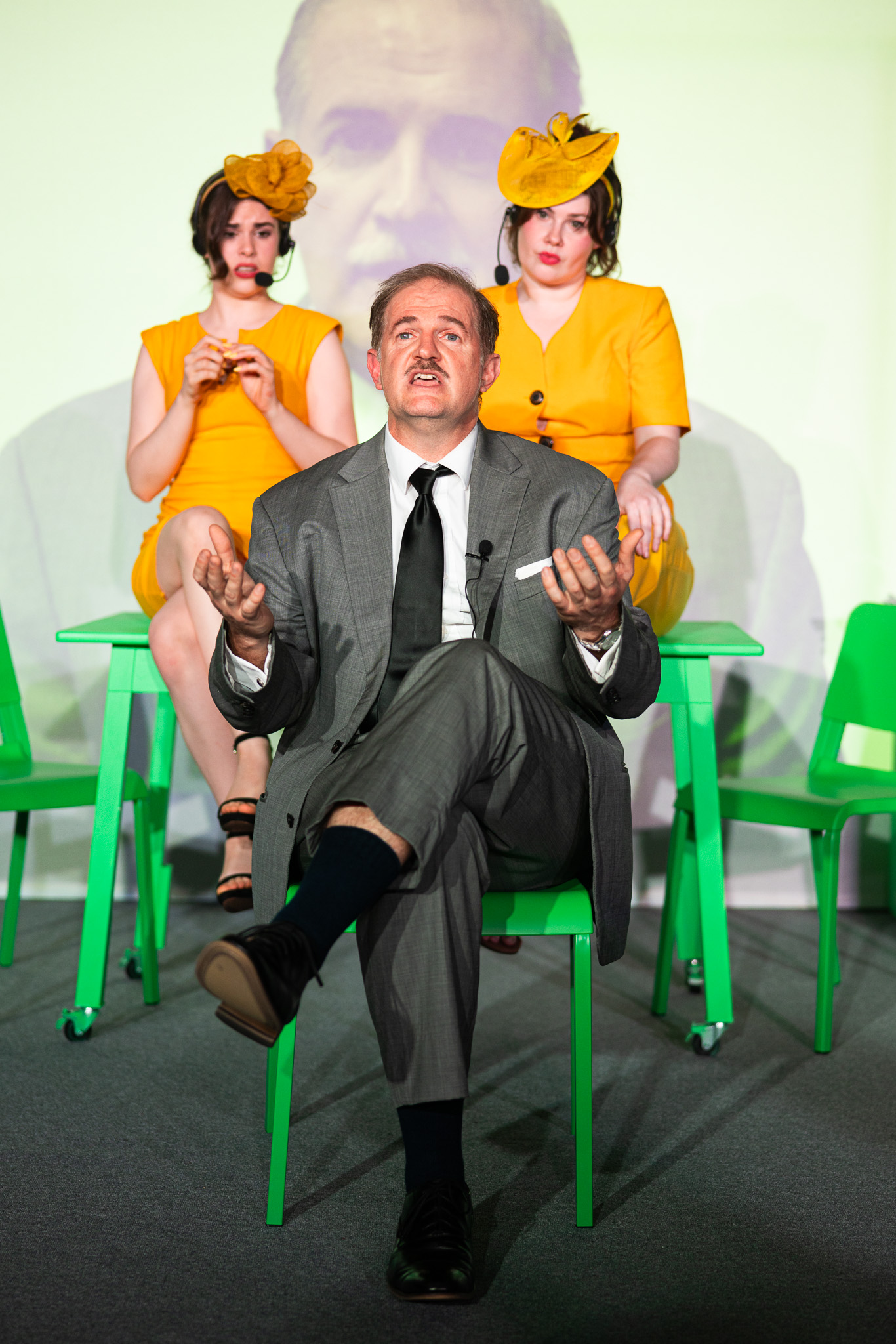
Disney Off Ice has made its world premiere at Studio 1, Yeerongpilly, presented by Observatory Theatre. This outrageous satire, the first script to be commissioned and developed through Observatory’s Telescope New Writing Program, is funny and absurd and asks interesting questions about the intersection of creation and capitalism, but I was left wanting to know more about the key characters’ stakes and motivations.
Written by Oliver Gough, Disney Off Ice takes its jumping off point from the urban myth that Walt Disney was cryonically preserved after his death from lung cancer in 1966. Directed and designed for this world premiere season by Lachlan Driscoll, Gough’s play imagines the unfreezing of this cultural icon and all of the mythos surrounding him, which has continued to grow and change in the half-century he’s been away.

It’s the year 2097, the planet has burned, and original cryogenics company Pause is falling behind its competitors as they expand into entertainment services. Disney’s theme parks and reputation alike are in tatters, and a hyper-personalised algorithm is delivering content so customised that no one is consuming the same content as their neighbour. Escalating wealth inequality means that the rich are only getting richer…which also means that Pause’s customer base is dwindling. In a desperate bid for market attention, they unfreeze their most premier client, one of the earliest adopters of cryonic freezing – Walt Disney. Reanimated, Disney is not a person but a marketing tool, and his legacy becomes a commodity that can be sold to customers who aspire for the same.
Pause’s slick marketing professional Joanna requests control of Disney when he returns. But Disney isn’t the wholesome family showman they remember from the past – he emerges from the tank swearing and sardonic, refusing to cooperate with his handlers and to take the medication that will help his thawing brain and body adjust to the future. A foul-mouthed egomaniac, Disney is increasingly disoriented and unpredictable, plagued by visions of his creations and pursued by a group of Disney fanatics who have been awaiting his return. Disney may be willing to trade his fading legacy for new fame…but the future has gone on without him, and there are other celebrities waiting to be unfrozen in response to shifting marketplace demand.

Oliver Gough’s writing is sharp and quick, and the show is packed with Disney references, of course. Disney Off Ice simultaneously indulges in nostalgia and warns against it, recalling a time before streaming wars and binge watching when popular and widely distributed media was a point of commonality and connection.
The world of the play, set only 70 years in the future, is eerily plausible and the idea of projecting beliefs onto a cult status figure is not only believable, but observable in our modern world. Disney Off Ice also speaks to the simultaneous dehumanising and mythologising of celebrities, the ethics of how we create and consume art, and the paradox of nostalgia: the future owes us nothing, and it is not possible to truly return to the past.

While the outer world of the play is quite clearly defined, I was left wanting to know more about the characters’ inner worlds and what was at stake for them at an individual level. All three of the women working at Pause expressed disdain for their industry and their workplace, but without much clarity as to why they remained there. This is especially true of Joanna, who seemed to have little at stake in the company’s future, as opposed to company owners Marin and Aspen.
Between Joanna’s unclear investment in Pause’s success and Disney’s aggression and arrogance, it was difficult to find an emotional foothold with the two main characters. This left the audience to empathise with the cultish Merry Band, represented by Bruno and Ajax. Their goals were very clear – to hold their god in the palm of their hand, and own him – and their direct address to, and jovial interaction with, the audience was very engaging.

Chris Kellett played Walt Disney as both charismatic and gratingly self-important, maintaining a consistent accent and great rapport with Joanna. During one of the climactic scenes, in which Disney commits to going off-script in a press conference, there was either a significant drop in the play’s tension or a series of forgotten lines by Kellett on the opening night.
Rebekah Schmidt played brisk, sharp-tongued Joanna and gave a great emotional performance, but I struggled to decipher how the emotion related to her characters’ stakes. Audrey Allen-Moore and Ophelia Novak played the beleaguered co-owners of Pause, Aspen and Marin, as well as a duo of talk show / live stream hosts, and Beau Doyle and Lachlan McGeary were a very engaging duo as Disney cultists Bruno and Ajax.

Costume design by Rebecca Day, who was also the Assistant Director of the production, tied in further Disney references and added to the world building. Lighting, sound, and projections designed by Noah Milne, with Lachlan Driscoll also contributing to the sound and projection design, crafted the world of the play very clearly. The shadow play used in Disney’s emergence from the cryogenic tank and the flickering lighting of his hallucinations, suggesting early animation on a film reel, were especially effective.

There were elements of eeriness in the use of sound and video design, with Disney and Joanna both delivering monologues in front of pre-recorded video of themselves, speaking out of sync with their silent projections. With Mickey Mouse now in the public domain, early Disney animations played on the screen before the show began and simple colour coding of furniture helped to distinguish settings, although it wasn’t always clear whether projected imagery was part of the setting or Walt’s visions.
Disney Off Ice was entertaining and outrageous, but beyond the comedy it had some interesting things to say about the intersection of celebrity, capitalism and cultural connection in our modern world, and left me wanting to know more about the characters and what they believed in.
To read more about Observatory Theatre, visit their website
 Backstreet Brisbane
Leave a comment