
Opera Queensland and Circa join forces once again for a lustrous new interpretation of Henry Purcell’s Baroque opera Dido and Aeneas, bursting with glamour and gravity-defying acrobatics.
Purcell’s Dido and Aeneas was first performed in 1689, with the libretto written by Nahum Tate. It is one of the earliest known English operas, as well as being Purcell’s only all-sung dramatic work.
Based on Book IV of Virgil’s epic poem Aeneid, Dido and Aeneas tells the tale of two doomed lovers. Dido, the Queen of Carthage, is restless until a storm delivers the Trojan hero Aeneas to her shores. Dido and Aeneas fall deeply in love and plan to marry, but their union is cursed by a sorceress who sends her minion, disguised as Mercury, to command Aeneas away. Heartbroken, but unwilling to defy the gods, Aeneas leaves Carthage and Dido dies.

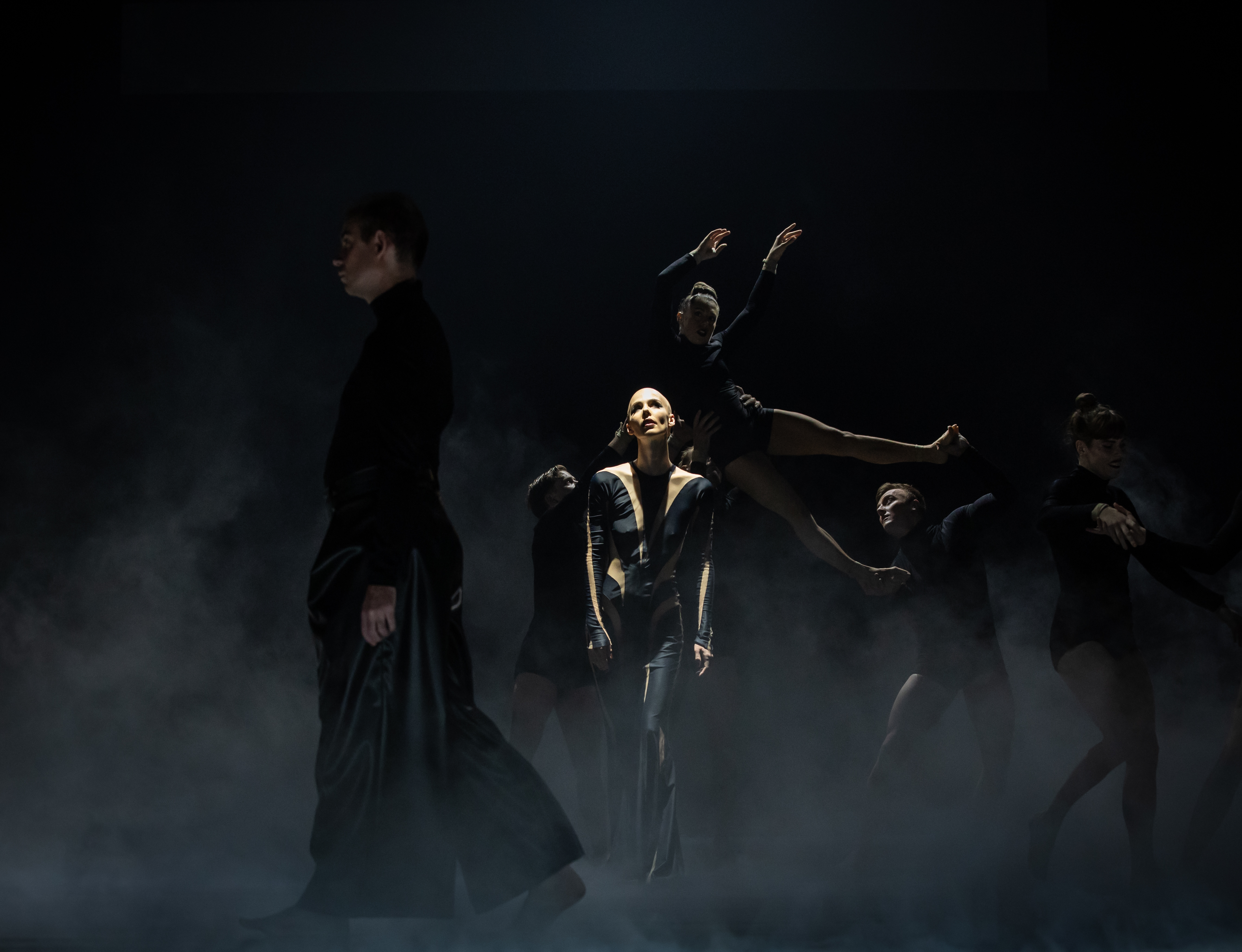
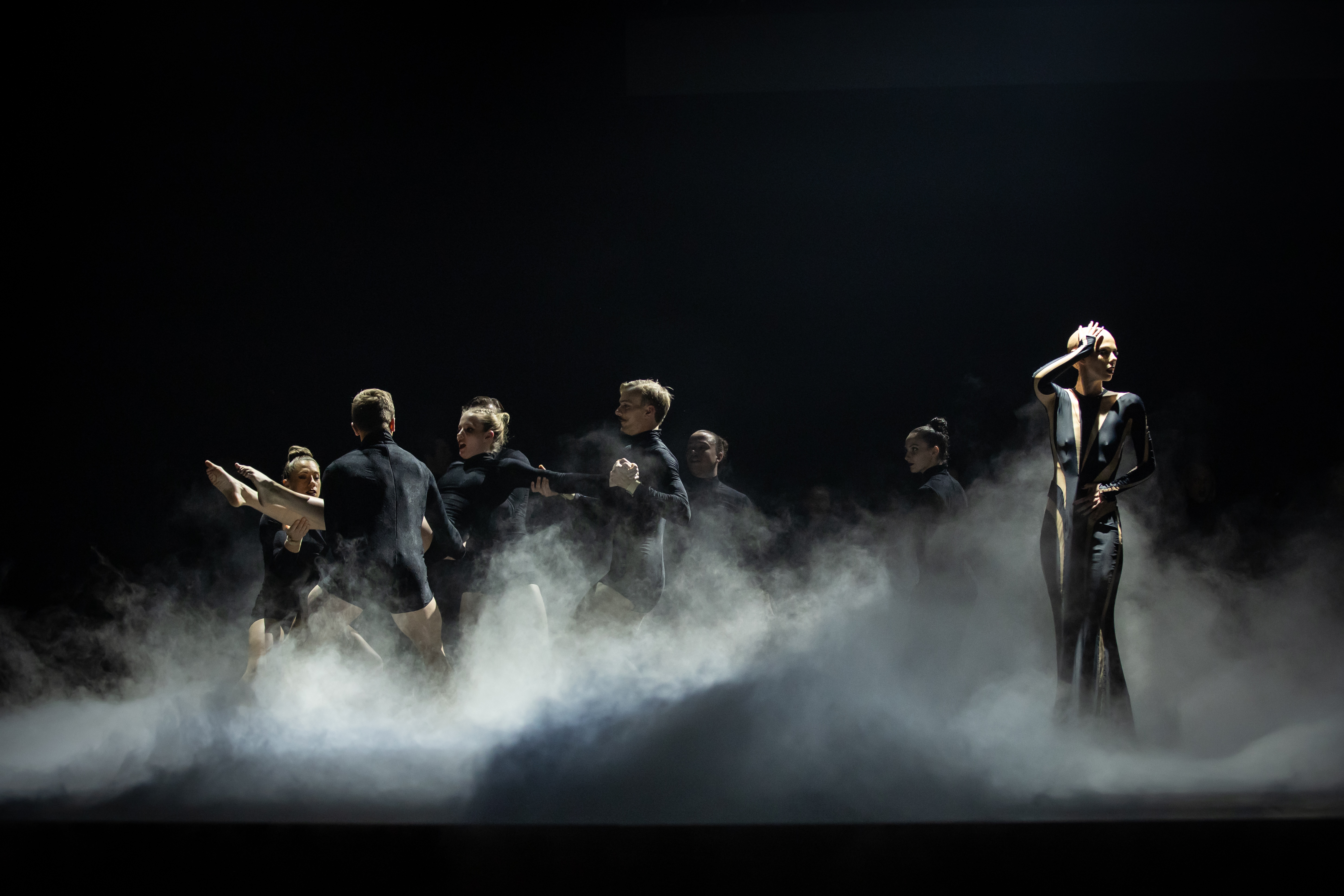
With a run time of 70 minutes, it’s a short production especially by three-act opera standards, but Dido and Aeneas has such a strong sense of momentum throughout. The stage is empty of props or set but is in constant motion with the stacking, swinging, and swarming of Circa acrobats as well as the movement of the Opera Queensland Chorus.
Directed by Circa Artistic Director Yaron Lifschitz, who also designed the minimalist staging, this new production of Dido and Aeneas fuses music and movement to tell an ancient story of doomed lovers with modern flair and spectacle. The opera is sung in English, and surtitles were projected across several different screens on the stage, some of which were raised and lowered throughout the performance. Scrolling text taken from a wide range of sources posed questions and quotes about love, life, destiny, and duty, and this scrolled as the audience took their seats as well as in parts of the performance.

This production of Dido and Aeneas opened with a new prologue, constructed by conductor Benjamin Bayl, which drew on Purcell’s significant catalogue of incidental theatre music. Elements of this were also added to the score itself, along with music by Purcell’s contemporaries Matthew Locke and Jeremiah Clarke, to create smoother transitions between some of the scenes. The music of Dido and Aeneas was thrilling, performed live by the Queensland Symphony Orchestra under Bayl’s baton.
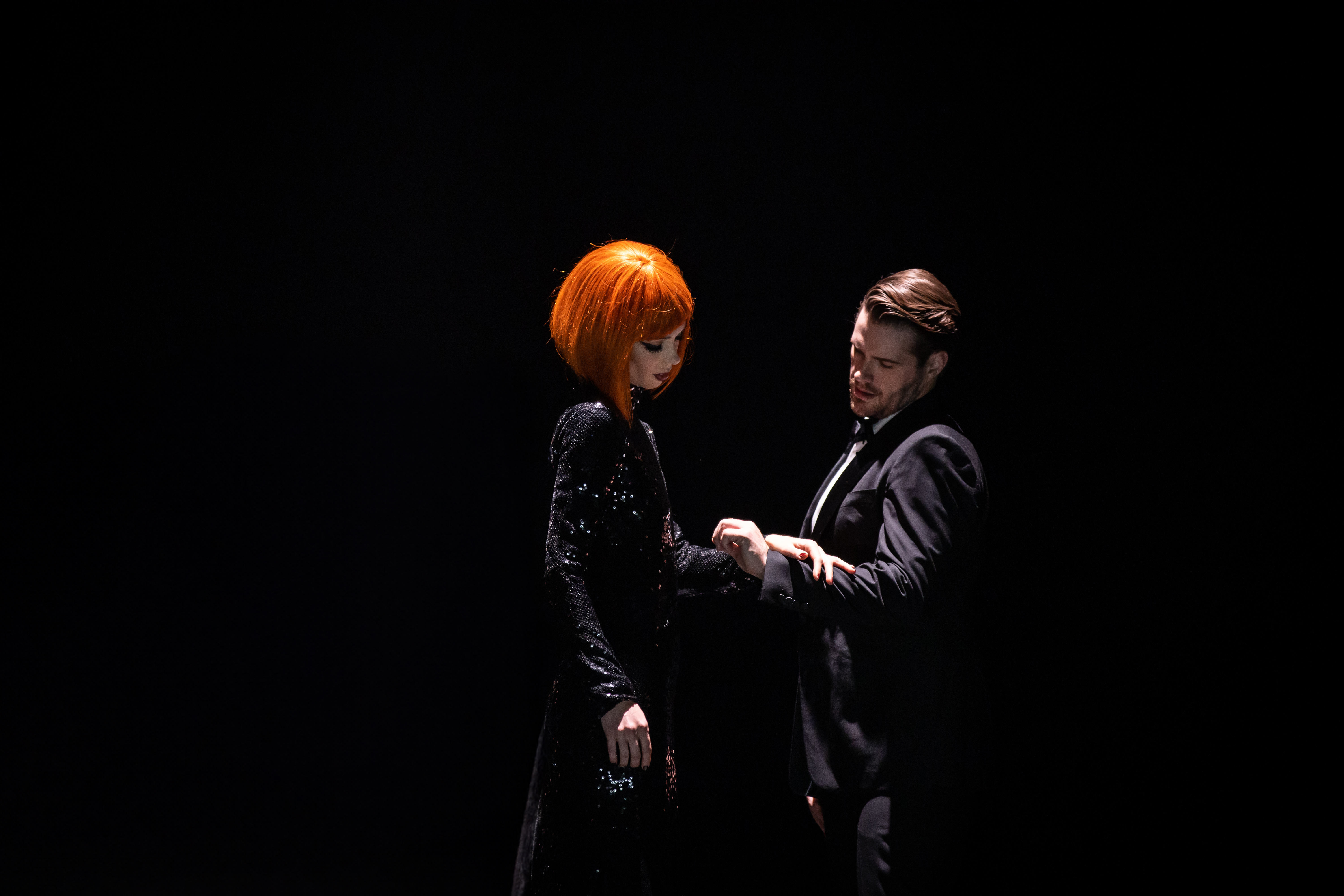
Costume designer, and Head of Design at Circa, Libby McDonnell wrote in her programme note that she was inspired by 1940s cabaret for Dido’s floor-length sequinned gown. Worn with a dramatic orange wig, Dido’s fishtail gown was shed onstage as she became the Sorceress, peeling away dress and hair to reveal a second, striped costume and a bald cap. For her famous final lament, Dido removed her gown and sang in flesh-toned underwear, a physical and narrative baring of self before her death.
Anna Dowsley performed the roles of both Dido and the Sorceress, suggesting themes of duality and self-sabotage in her love for Aeneas. Dowsley brought a distinct characterisation and energy to each character alongside her extraordinary singing, and had excellent onstage chemistry with Sebastian Maclaine as Aeneas. The Trojan hero was reimagined as a classically suave leading man in a boxy tuxedo and bowtie and Maclaine gave an expressive performance in this role, with a highlight being Aeneas’ impassioned solo as he prepared to leave Carthage.

The Opera Queensland Chorus and the Circa acrobats all wore the same costumes, a lace bodysuit under tailored faux leather pants. The two groups of artists blended together, and the swirling patterns of the lace added to the visual sense of motion and momentum. Similarly, soloists slipped fluidly in and out of the larger group. The acrobats (and backstage team) seamlessly handled various apparatuses, from poles and silks to trapeze and a tightrope.

Using a black-and-white colour palette with warm splashes of red and orange, Dido and Aeneas was filled with striking shadows and silhouettes. Lighting design by Matthew Marshall was a key part of the visual spectacle, making use of dramatic spotlights and shifting the parameters of the stage without props or sets, only curtains and scrims.

Dido and Aeneas plunged into all of the drama and tragedy of a three-act opera in just over an hour. Incredible vocal performances and the awe-inspiring physicality of the Circa acrobats merged two art forms seamlessly, mutually elevating both, in this sensational new production.
Dido & Aeneas will be performed at the QPAC Playhouse, South Brisbane, from 11 – 27 July 2024
For ticketing and further information, visit the Opera Queensland website
 Backstreet Brisbane
Leave a comment