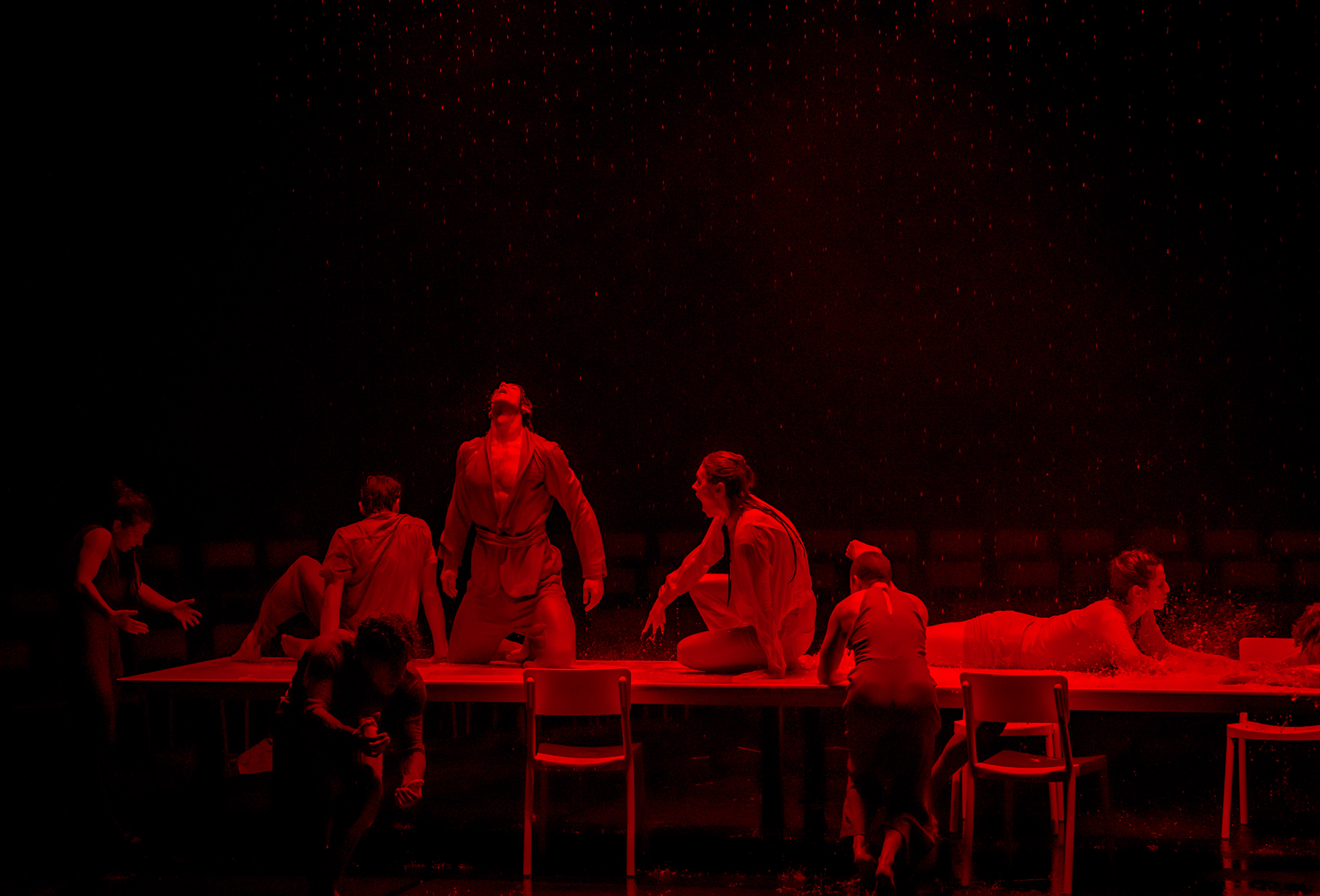
The headline show of Brisbane Festival 2023, Salamander brought together contemporary dancers from Brisbane’s Australasian Dance Collective with guest artists and international collaborators to produce a multifaceted spectacle on an ambitiously large scale.
Lead by director and choreographer Maxine Doyle and renowned designer Es Devlin, Salamander combined dance, song, poetry, and kinetic sculpture across a sprawling warehouse space, exploring themes of apocalypse, adaptation, and humanity across these multiple mediums.

Director and choreographer Doyle wrote in her programme note that Salamander was inspired by J.G Ballard’s 1962 science fiction novel The Drowned World, considered one of the founding novels of the climate fiction sub-genre, and by the biblical last supper. I didn’t have that context going into the work, but nonetheless the imagery of a final meal, a climate emergency, and an increasingly unliveable earth were very clear. Water, time, death, and rebirth, all swirled through Salamander, and the name of the work was presumably taken from the giant reptiles that evolve in the apocalyptic conditions and prey upon humans in Ballard’s novel.
Salamander was performed across two distinct settings, both contained within a warehouse at Northshore, Hamilton. The audience entered through a winding hallway lit in red neon, emerging onto a mezzanine above a transparent labyrinth surrounded by a pool of dark water. As the first half of Salamander was promenade style, audience members could choose to stand on the mezzanine or descend the stairs for a different perspective. The audience was later guided by festival staff to a different area and seated for the remainder of the performance.

Installation artist and stage designer Es Devlin created the striking stage sculptures, including a transparent labyrinth surrounded by an inky moat of shallow water, and the kinetic set of the second performance space which featured an enormous spinning table and pouring rain that soaked the dancers and pooled on the stage.
The use of water in both performance spaces was visually spectacular, complemented by lighting design from Ben Hughes. Costuming designed by Bruce McKinven also changed between the two halves of Salamander, from flesh tones and partial nudity in the first half to individually unique costumes in an identical shade of red in the second half.
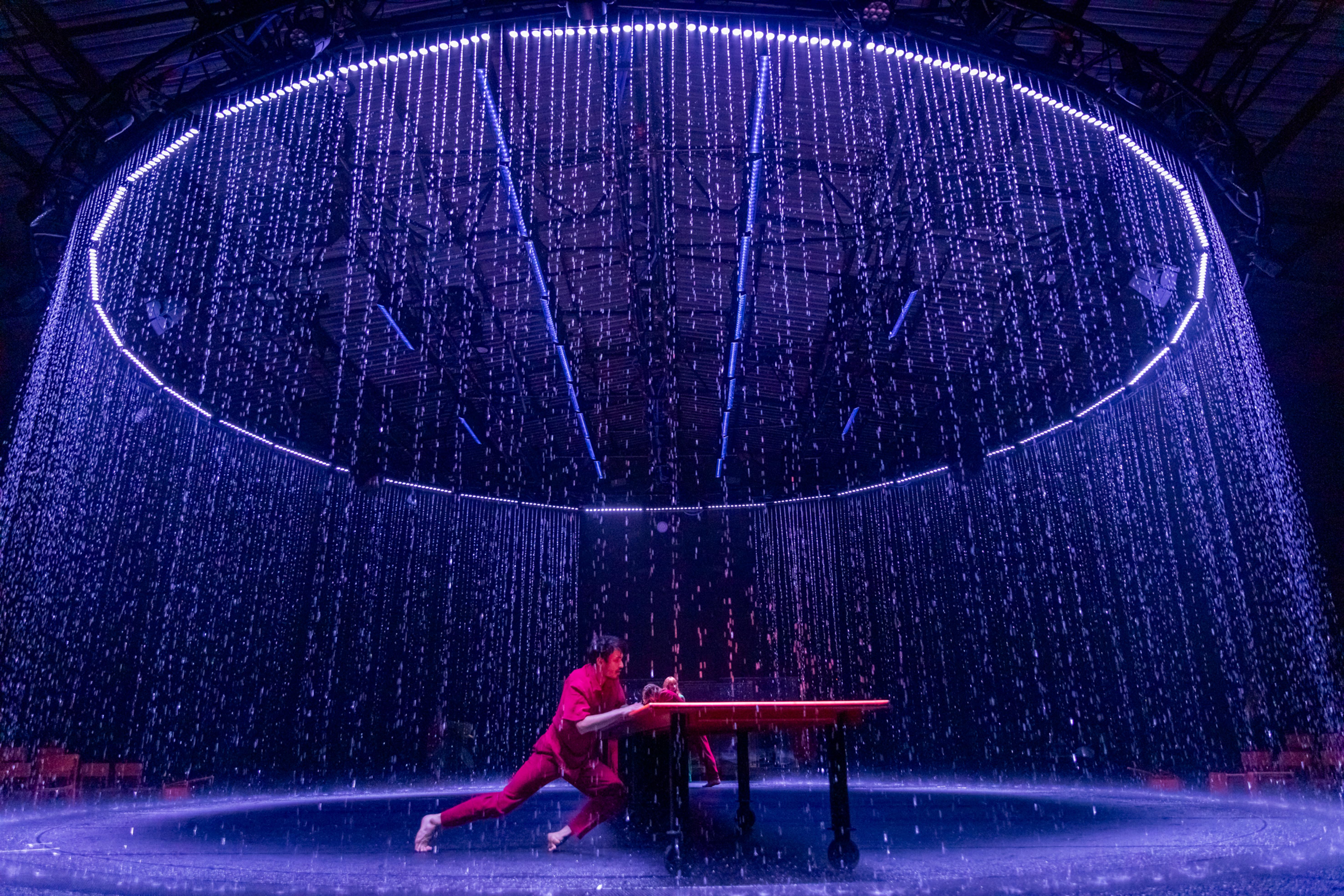
From tentative exploration of the watery world outside the labyrinth’s transparent walls, to a party for the end of the world, and the emergence of playful amphibians, the dancers engaged with Devlin’s drowned world in a way that held loosely to narrative threads drawn from Ballard’s novel. There was no linear storytelling that I could discern (although, I am not very familiar with the source material), but the themes were held lightly and woven effectively throughout the work.
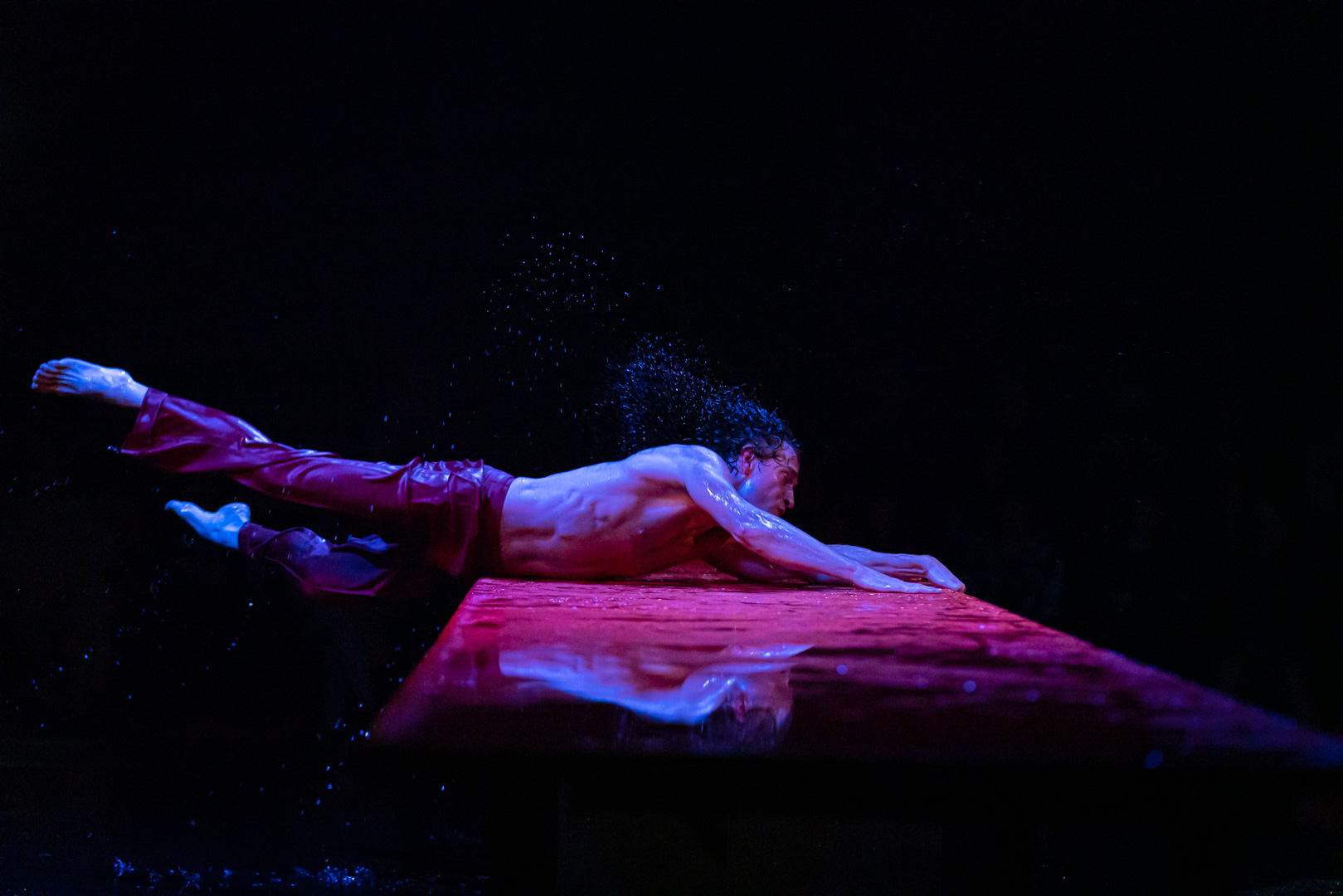
The eight (8) dancers – May Greenberg, Paul Zivkovich, Gabrielle Nankivell, Jag Popham, Jack Lister, Harrison Elliott, Lilly King and Chase Clegg-Robinson – demonstrated exceptional athleticism and stamina, as well as emotional expressiveness, in executing Doyle’s highly physical and acrobatic choreography. The choreography was developed in collaboration with the ensemble, and anyone familiar with Australasian Dance Collective’s work in recent years will recognise their signature movement style and the ways in which the choreography plays to the individual strengths of the dancers. The choreography and style of movement, while recognisably ADC, often contained a sense of threat and animalism, from slithering and splashing to explosive leaps. The performance atop and around the kinetic structure in the second space – a huge table that spun 360 degrees, evoking the spinning hands of a clock and the passing of time – was impressive as the dancers managed inertia and balance in addition to the demanding choreography.

Salamander’s composer, sound designer, and vocalist Rachael Dease also joined the dancers onstage at different times throughout the performance’s second half, and her rich voice was captivating in the cavernous space. Other sound design was subtler, although there was a memorable sequence set to Giuseppe Verdi’s iconic Requiem Dies Irae.

Joy Harjo’s poem Perhaps the World Ends Here was read as a voiceover by Brisbane-based artist Margi Brown Ash as the frenetic pace of the work began to slow, and the dancers returned to the sculpture as a kitchen table. Despite its themes of apocalypse and destruction, Salamander circled back to the safety and comfort of gathering and shared humanity. Seated in two rows of chairs around the stage, the audience was similarly gathered together in the dark, and the final moment of the performance offered a glimmer of hope for the future.
An ambitious undertaking, Salamander was an impressive visual spectacle of colliding dance and design, performed with impressive strength and stamina by the artists.
Salamander will be performed at the L Shed Dock B, Northshore, Hamilton, from 1 – 24 September 2023
For ticketing and further information, visit the Brisbane Festival website
 Backstreet Brisbane
Leave a comment