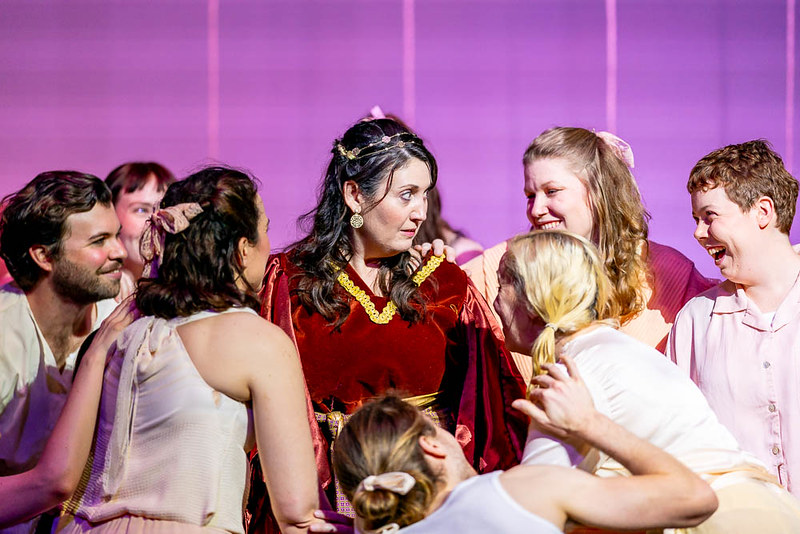
Content warning: physical and sexual stylised violence and mild coarse language.
Queensland Shakespeare Ensemble brought their signature dynamism, theatricality, and musical skill to Margaret Atwood’s The Penelopiad, a contemporary retelling of Homer’s epic poems that focuses on Penelope, the wife of Odysseus, and her twelve maids who are hanged in The Odyssey.
In The Iliad and The Odyssey, two epic poems from ancient Greece attributed to Homer, Odysseus spends ten years at war with Troy and a further ten years trying to get home to Ithaca, repeatedly thwarted or redirected by the sea god Poseidon. Meanwhile, his wife Penelope is left alone in Ithaca with Odysseus’ aging parents, to raise their son Telemachus and run the kingdom alone. This is the focus of Atwood’s adaptation, which was published first as a 2005 novella, then adapted for the stage by the author to premiere in 2007 at the Royal Shakespeare Company’s Swan Theatre in Stratford-upon-Avon, England.
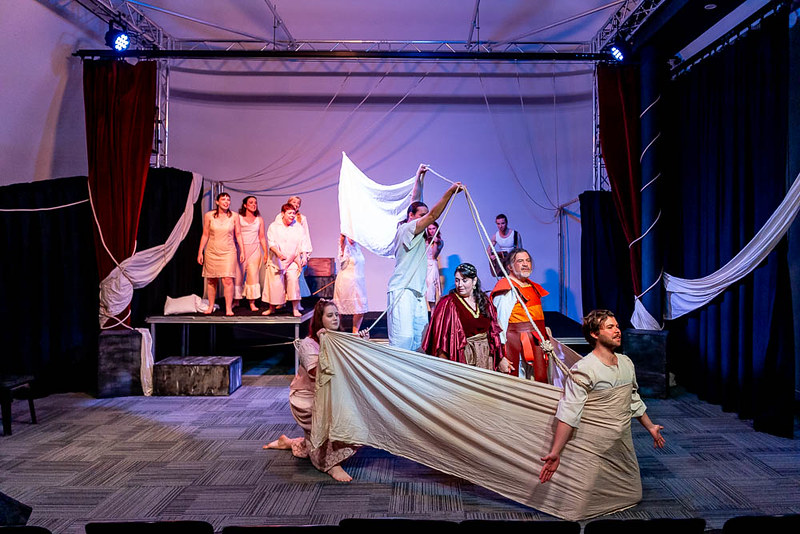
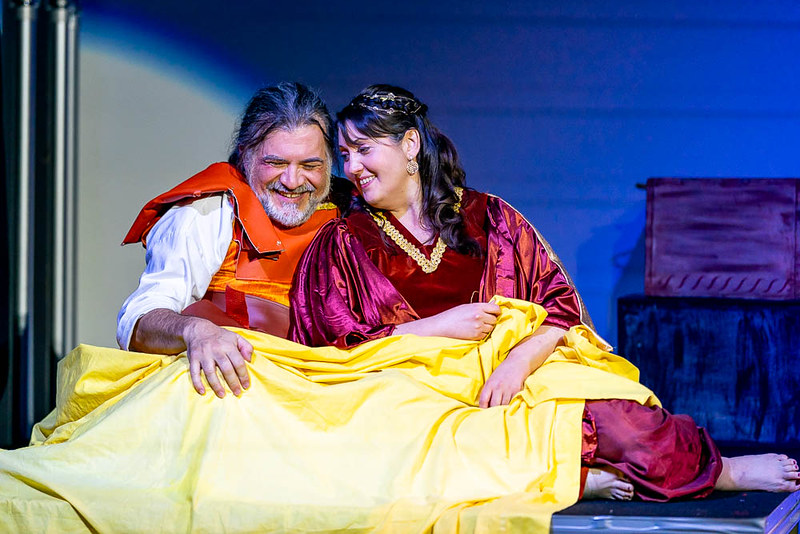
Speaking from the underworld, Penelope (Liliana Macarone) narrates her life story for the audience – from her birth in Sparta as the daughter of a Naiad and her father’s attempt to drown her as an infant, to living in the shadow of her beautiful cousin Helen (Leah Fitzgerald-Quinn). Through an act of trickery, Odysseus (Rob Pensalfini) contrives to win her hand in marriage and, once they are married, takes her to his remote island kingdom of Ithaca. Then Helen is taken to Troy and Odysseus sails to war, not to be seen again for twenty years. The Penelope who marries Odysseus is a naïve young woman, and the queen who speaks from beyond the grave reflects on how little she knew.
Rumours of Odysseus trickle in over the years – providing additional context for his adventures in The Odyssey – but no one is sure if he is really alive, or if he will come home. As crowds of restless suitors gather in her home, hoping to marry the widowed Penelope and seize her kingdom, Penelope enlists the help of twelve maids – the youngest and most beautiful, who she has helped to raise – to spy on the suitors and help her to keep them at bay. In this role, the maids are frequently harmed and abused by the suitors, but Penelope persists with her efforts, unable to see another option.
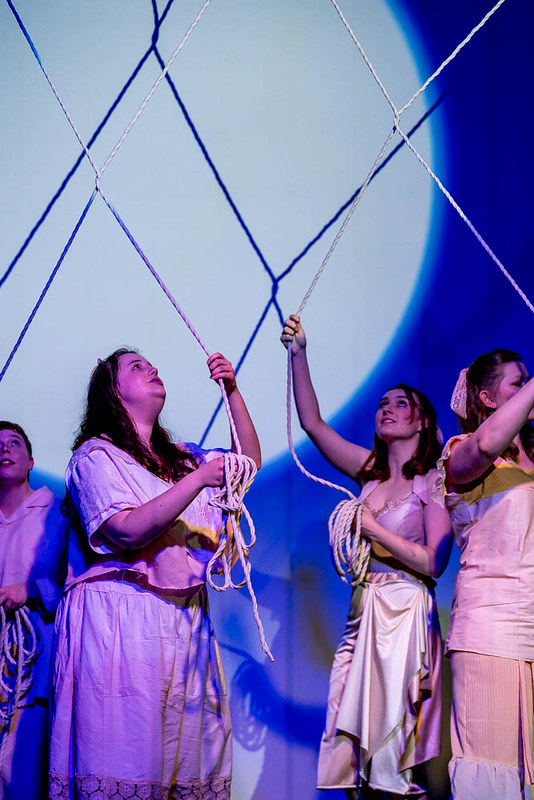
When Odysseus finally returns to Ithaca, in disguise, he kills the suitors and has the maids clear their bodies away before ordering his son Telemachus (Riley Anderson), now a young man, to hang them for their faithlessness. Despite being absent for twenty years and returning to an intact household, Odysseus underestimates his wife and, as a result, her twelve loyal maids are sentenced to death without her knowledge. Penelope is absolved of some responsibility, as she has been drugged at the order of her husband, but the maids haunt her ruthlessly in the afterlife.
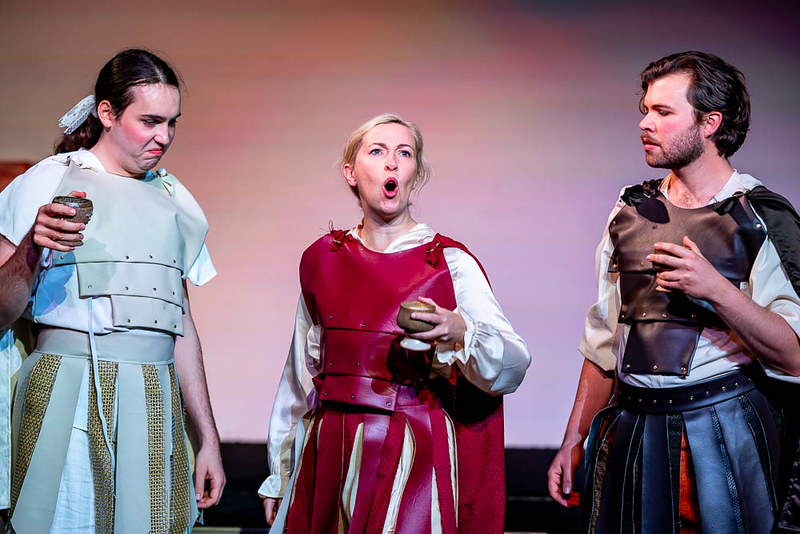
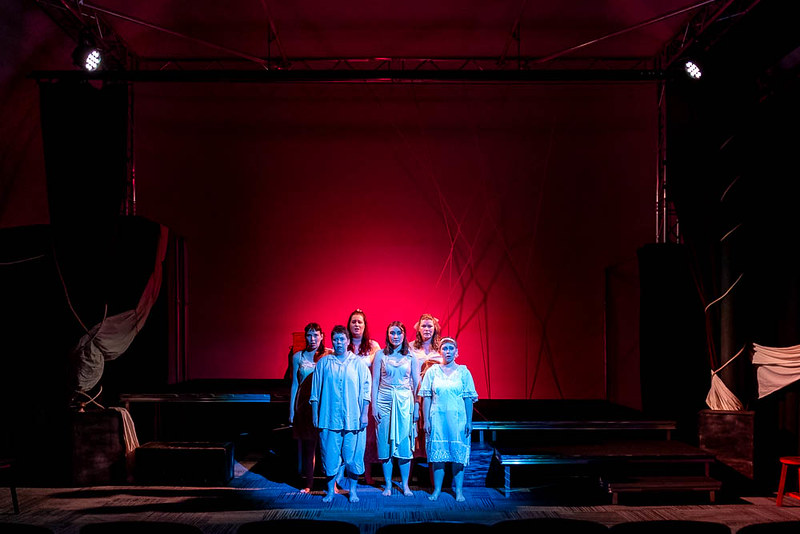
Both the novella and script alternate between prose and verse, a Greek chorus of the twelve hanged maids, and this was accompanied by live music performed onstage by the QSE actors. In The Penelopiad, the maids are given a voice that winds through the play in rhymes and songs, with musical direction and composition by Rob Pensalfini, as well as through collective monologues that expand upon their drudgery, dreams, and day-to-day lives, particularly in contrast to a royal child like Telemachus.
Atwood’s treatment of her female characters lacks complexity at times, especially in her interpretation of Helen as cruel and shallow. At one point in the play, Penelope laments her status as a paragon of wifely virtue and patience, which has become “…a stick used to beat other women with”; however, Atwood’s retelling treats Helen in the same way. As a foil to Penelope, Helen is vain, flighty, and seemingly flattered to be the cause of countless deaths in the Trojan war. Although Helen is objectified from a young age and is either abducted from her home or takes great risks to leave her husband (depending on the interpretation), there is little compassion given to her character. The script also places emphasis on Penelope being clever, and Helen being beautiful, in a way that suggests that these are mutually exclusive traits.
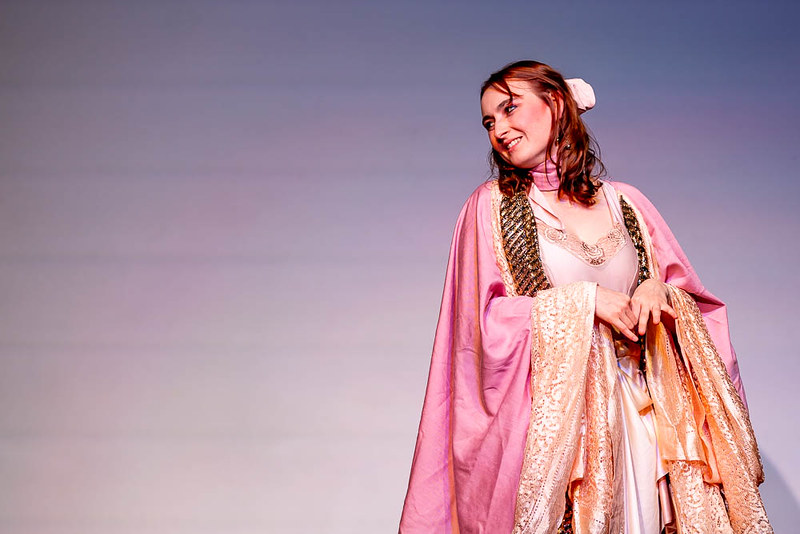
Queensland Shakespeare Ensemble’s production of The Penelopiad is directed by Rebecca Murphy and stars a cast of thirteen, led by Liliana Macarone as Penelope. Macarone gave an excellent performance, bringing gravitas and sincerity to the role and matching the energy of Pensalfini’s Odysseus. Rebekah Schmidt, who was also the Assistant Director, was a standout performer as the maid Melantho of the Pretty Cheeks.
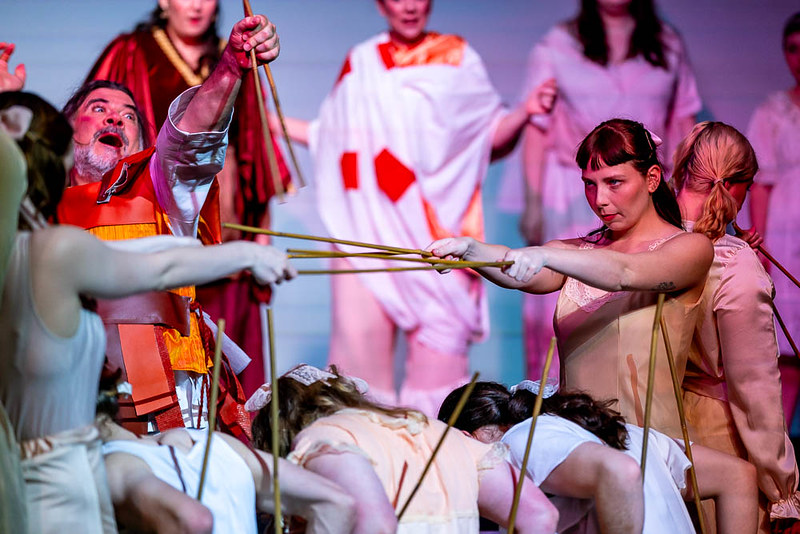
Murphy’s direction imbued this mythic retelling with dynamic and meaningful movement, including fight direction by Jason McKell, creating strong and memorable images through the use of physical theatre and props, such as the weaving (and unweaving) of Laertes’ shroud and the hanging of the maids. In addition to playing supporting characters such as the suitors and Odysseus’ parents, the ensemble worked as a committed and cohesive whole, which heighted the overall impact of the performance.
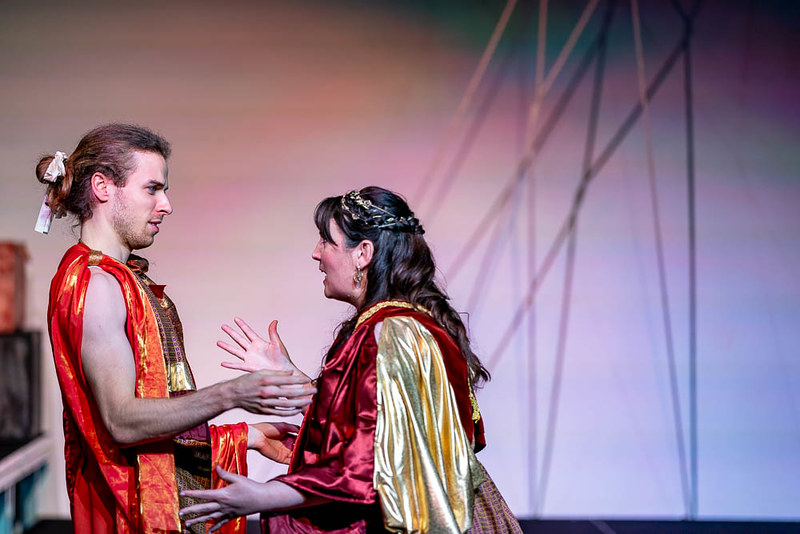
Costuming designed by Leah Fitzgerald-Quinn used a patchwork of textures in complementary colour palettes, and the actors moved smoothly across a multi-tiered set designed by Josh Murphy. Lighting designed and operated by Tim James added to the atmosphere and emotion of each scene, as well as contributing to the setting.
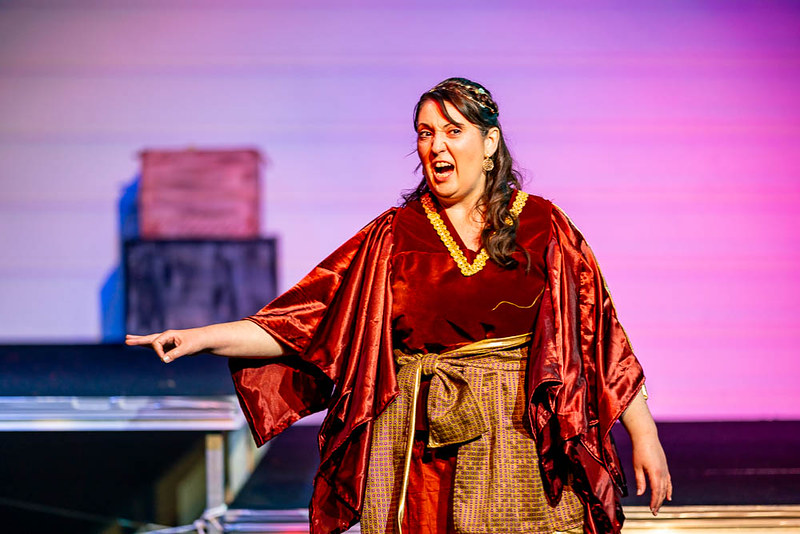
As a contemporary take on an ancient story, The Penelopiad speaks to the complexities of class, power, and gendered expectations, especially as they relate to ideas of truth and justice. The more I dug into the story and its themes, the further the work expanded in my memory, and the strong imagery and rhythmic songs of QSE’s The Penelopiad have stayed with me for weeks after the performance.
The Penelopiad is playing at PIP Theatre, Milton, from 25 August – 10 September 2023.
For ticketing and further information, visit the PIP Theatre website


Leave a comment