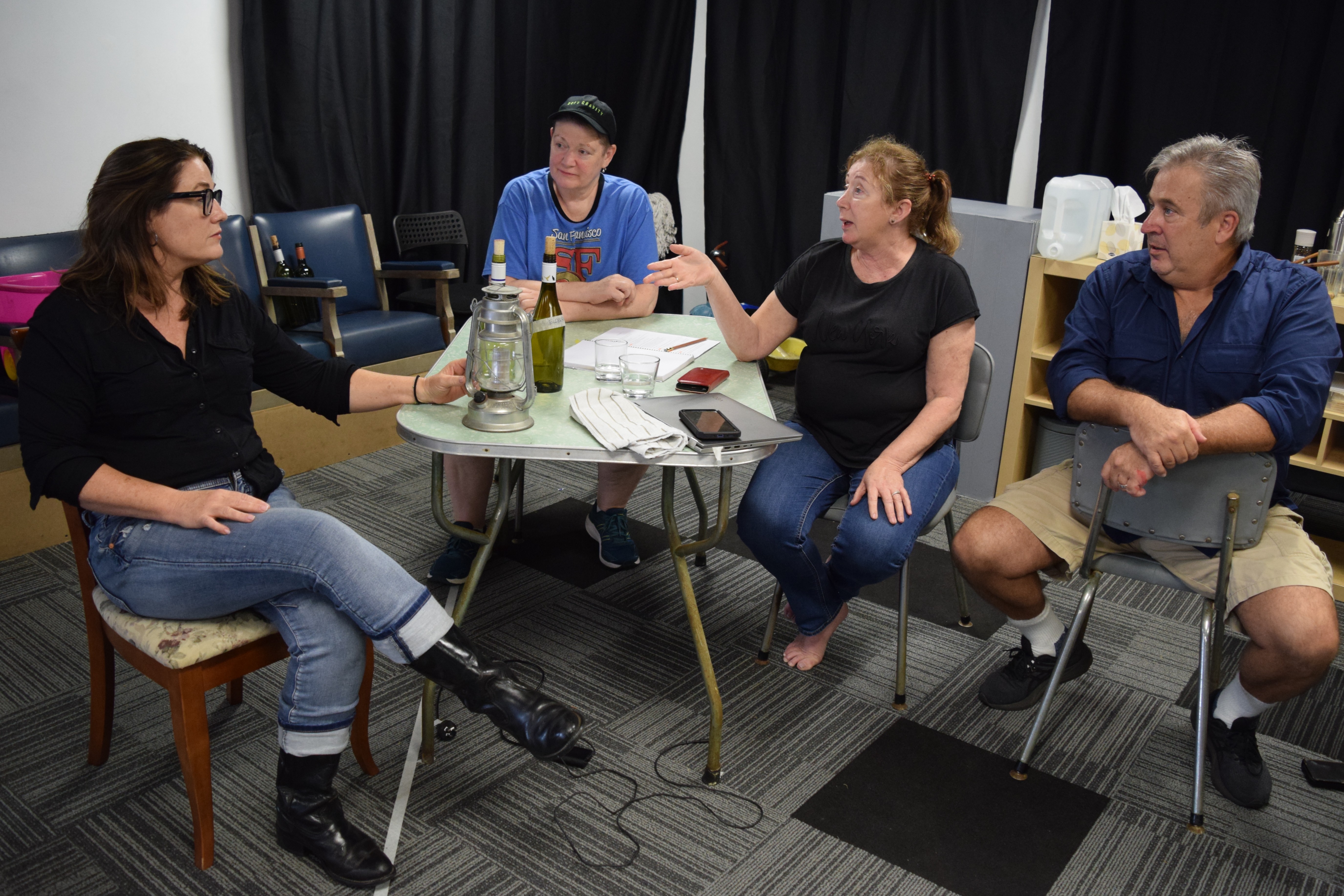
Lucy Kirkwood’s play The Children will make its Queensland premiere this month in Milton, co-presented by PIP Theatre, A Moveable Theatre, and Amanda McErlean. During a break in their rehearsals, I sat down for a chat with the cast and some of the creative team to discuss legacy and responsibility to the future, substantial roles for actors over 60, and why this play inspired by a 2011 nuclear accident remains a story for right now.
Since we have quite a big group, could you each please introduce yourself, and your role in the production?
Heidi Gledhill: I am the director of The Children, and predominantly I am a theatre director and an intimacy director and coordinator.
Amanda McErlean: I am an actor, and a producer for The Children, and I also work front of house and as a tour guide at QPAC. I play Rose in The Children.
Julia Johnson: I play Hazel in The Children. I’m an actor, and I’m one of the producers.
Terry Hansen: I’m the third of the three co-producers on The Children. I was 40 years in standup, 20 years of radio. A long time ago I used to be involved in theatre, with A Moveable Theatre, and this is my return to stage after 25 years. I play Rob, who is a boozy ratbag, so it’s been quite a reach [laughs].
Desley Martin: I’m the dramaturg. I do a bit of assistant directing sometimes, I’ve worked through Room to Play independent theatre since 2014. I work with the script, so I do all the research, break down the script into characters, themes, arc and that sort of thing.

How did you each first encounter this play, and what was your initial reaction to the text?
Julia: I was overseas and Amanda said to me, ‘are you going to the UK?’ I said yes, and she said ‘Go down to the National Theatre and buy this play and read it’. I sent her a photo of me picking it up. So, Amanda found it first, then I read it and went, this is a fantastic play.
Amanda: I just happened to be in a bookshop looking for another book. I had stopped looking for plays in bookshops because no one was carrying them anymore. I was surprised that it had a whole bookshelf full of plays, and I saw this one I hadn’t heard of, The Children. The first thing I saw was that it had three characters and they were all over 60 years old. And to be honest, before I read the play, I thought it was actually three women because in the play, Rob is called Robin.
I had just been working with Julia on Talking Heads by Alan Bennett, and Terry had a lot to do with the production side of that, and I thought, wow, wouldn’t it be great to have a husband and wife playing the husband and wife? I read the play and thought, this is awesome, I’ve got to see what they think of it.
I had to wait for so long…I got all excited when Julia showed me the photo of her buying it. She said, ‘we’re just going over to Amsterdam, and I’ll read it on the train.’ I’m waiting….and waiting…and waiting…and I thought, fuck, she thinks it’s terrible, she doesn’t like it at all! It was ages, weeks, and I saw that they were back home so, finally, I sent her a message and she said ‘oh no, I poured my water bottle all over it, we had to dry the play out, I’ve only just had time to read it now. Yes, I love it, it’s great.’ Oh my god! [laughs].
Julia: On the train I’d left my water bottle open and it leaked in the bottom of my bag and the whole book was soaked. I thought, if I start trying to read it I’m just going to destroy it.
Amanda: I was already so invested after reading the play, the wait was just killing me. I thought, what’s wrong with me that I think this play is so great and they don’t like it? [laughs].
Terry: I got the message that there were three women in the play and I said to Amanda, don’t you pigeon-hole me [laughs]. Coming back to the stage it is massively advantageous to be with these two very experienced actors. I think there’s a lot of Rob in my life already, which is not necessarily a good thing all the time, so I was very excited to be included.
Amanda: It’s really unusual to have three actors over 60 onstage, and I think that’s pretty exciting because, actually, the demographic of theatregoers happen to be that age as well, and so to see themselves represented is amazing.
Terry: How did you put it? It’s nice to not be playing the grandparents, or the grumpy guy up the street.
Amanda: To have people in that age group be the protagonist, be the story, not just an addendum to the story, that’s very rare.
Terry: It certainly is a conversation for now and it’s interesting that [playwright, Lucy Kirkwood] chose retired nuclear physicists as the ones to grapple with what they created, what had gone wrong, and their responsibility for that. The rest of it is just a full-on relationship roller-coaster.
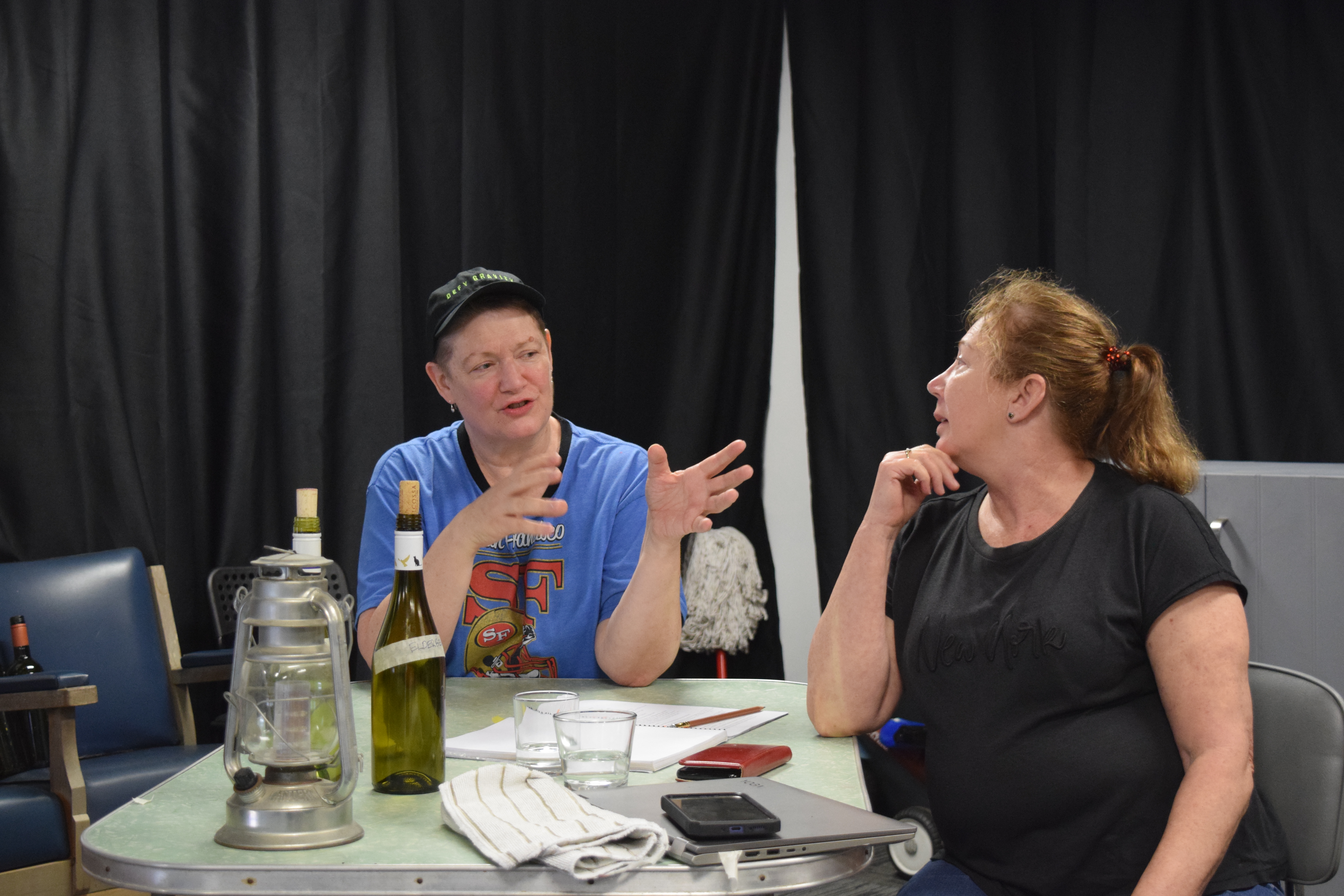
The Children was inspired by the 2011 nuclear accident in Fukushima – in what ways do you think it is still a play for now, 15 years later?
Amanda: The spectre of nuclear power and nuclear power stations hasn’t really gone away, and even though they lost the election they haven’t discarded that as a policy. There are a lot of people who want to go in that direction.
Desley: It’s for debate as well, you know, there’s two sides. Like Amanda was saying, a lot of people I’ve encountered do want nuclear energy and a lot don’t. They’ve both got their pros and cons.
Terry: We have engaged with some young students, who will be coming to the preview night, on that nuclear aspect and climate change direction. Actually, far more in this play is the relationships between these three people. They’ve come to a point – which we can’t give away, or we’d have to kill you – which will bring them to questioning all the choices they made in their lives. I should say, while it sounds intense, in a nuclear way and a relationship way, it is very, very funny.
How do you balance that, as actors and creatives, the comedy and the heaviness?
Heidi: I think the humour and intensity and drama is always held in a beautiful fine balance. A tragedy is never far from a comedy, and the brilliance of these actors is they can shift that really beautifully, with nuance. We just did a scene that started with absolute joy and humour and ended with devastation, and that was just 10 minutes. They move through it in a way that we are taken on that journey completely.
Desley: The whole play moves like that, in a nice rhythm of highs and lows and surprises and mystery.
Terry: There’s dancing!
Julia: It’s not a highlight.
Amanda: Speak for yourself!
[laughter]
What have been the biggest challenges and rewards in preparing for this show?
Julia: Without giving too much away about Hazel…initially you think you’re seeing all of her but you’re only seeing that one-tenth on top and there’s a whole lot underneath. I just love that, searching for what it is. I think all the characters are like that, from my perspective. That’s what’s rewarding.
Amanda: I think one of the big challenges is that it’s originally a British play. Lucy Kirkwood has given us permission to set it in Australia, and we have changed a few things, but in general there is a rhythm and some turns of phrase that aren’t necessarily how we would say them, and that is the hardest part to learn. It’s all for a reason, it’s a very melodic script and has a certain rhythm and there’s commas and full stops in certain places that you just have to learn. It will sound like we’re just making it up as we’re going along, it sounds like people are babbling bits of sentences, but it’s all on the page.

Heidi: Another challenge is it’s quite prop-heavy, and there’s a tiny stage, so these are the choices that the set designer has made to keep it very intimate and claustrophobic. Yet, how do you keep a lot of interesting staging and blocking, and how do we keep the dynamic nature of this in a very small space without feeling too crowded or bashing into each other? I think from a composition point of view, that’s a challenge on my end.
Terry: As Amanda alluded to, it’s Shakespearean insomuch as if you return to the script and you hit the punctuation, hit the moments, it tells you how the character is balancing the ideas. Not just intellectual, but emotional ideas. It’s very exciting, it’s a wonderful script, but I can’t possibly get to the next scene without making sure I’ve got a sense of what has just happened, for the actor as well as the character. The space had changed again, the stakes have changed again, the knowledge of the character and the audience has changed again.
Has the play shifted, or reinforced, any of your own perspectives on the issues it deals with?
Heidi: I think every play that we do, the character will teach us something and the story will teach us something. We don’t walk away from a play without having grown in some way.
Terry: I think I’ve seen the character I play…I’ve seen him outside before, and I haven’t always liked him. I’m not going to say I one hundred percent like him, but I get what he’s doing, I believe, and I get why he’s doing it. If I can be there, then the audience can decide to like me or not like me. One of the traits of such people is that they have enough liking of themselves to get them through.
I think each of our characters has a different spin as to what is life affirming. Rather than talking about a relationship with death, when you come to a point where you’ve got to make decisions, what is it that you feel you’re losing?
Amanda: I think there is a big contrast in the play between the big picture and the small picture. There are portions of the play where some of the characters are in the small picture and others are in the big picture, then that may shift. I think that’s sometimes how it can be in life. You can get stuck in the small picture stuff and not see what staying in that small picture can do to the big picture.

What do you hope an audience takes away from seeing this play?
Heidi: I’m going to go broad and say, love of theatre. We are doing theatre with so much energy and passion and commitment. It’s always going to be undervalued, financially and the rest of it, but we give it our all. We do it because we deeply love the transformative power, and joy, the storytelling, the congregation of people and community of theatre, bringing people together in real life.
Touching, sweating, blood, tears, love that stuff. We want it to go through the generations. Our legacy, for our children, is that they love theatre too. It has survived millennia and it’s going to survive more if we can keep the young blood coming through, watching this and going ‘whoa! I’m moved, I want to see that, I want to bring my kids to that, I want to do that, actually.’ It’s such a good play, you won’t walk away from it and not be moved in some way.
Amanda: I think I want them to go out and tell other people to come and see it.
Julia: My favourite pastime is theatre so yes, I want them to go out and tell other people to come and watch, enjoy theatre.
Terry: I’d like the audience to be full of people who have made some of the choices made by the three characters. Own your choices because they are what you’ve got.
Desley: Whenever I leave the theatre I love the feeling…there’s a moment of silence when you just think about everything, and then you start to discuss it, unpack it. I would like people to walk away with that moment of silence inside them.
The Children will be performed from 4 – 21 June 2025 at PIP Theatre, Milton
For ticketing and further information about The Children, visit the PIP Theatre website
You can support The Children via the Australian Cultural Fund here
 Backstreet Brisbane