
Please provide a brief introduction to who you are and what you do, in a broad sense and also in relation to Brisbane Bookshops.
Matthew Wengert: I mostly think of myself as an historical researcher, with a focus on Queensland history, but I also have a small publishing business called AndAlso Books. I work part-time at the Ration Shed Museum in Cherbourg. AndAlso Books’ earliest projects were co-published with the Ration Shed Museum, and our most recent book was co-published with Woodford Folk Festival. Brisbane Bookshops is our 14th title, and there are several forthcoming projects on the stove for 2024.
Anne Richards: I am a writer and academic, teaching for many years at Griffith University. I co-edited Brisbane Bookshops with Matthew as well as writing several sections on major historical bookshops. My memoir, A Book of Doors was published by AndAlso in 2020 and is based on the student radical movement at the University of Queensland in the late 1960s and 70s. Previously, I co-edited Making Books: Contemporary Australian Publishing with Prof David Carter, which highlights a sweet synergy of interests.
Bianca Millroy: I’m a Brisbane-based freelance writer and editor, currently completing my PhD at the University of Queensland in creative nonfiction/science communication. Broadly, I’d describe my writing as a blend of historical and literary fiction, usually with a gothic mystery at the centre. It was through AndAlso Books that my first full-length editing opportunity arose in 2020, as editor of Steve Capelin’s historical novel Paradiso. This has led to several editing projects since, including as co-editor of Brisbane Bookshops, which I am incredibly honoured to be involved in.
How did Brisbane Bookshops come about? What was the process like to compile such a diverse anthology that includes historical information and imagery, interviews, and personal experiences?
Matthew: The idea has been quietly growing for a few years, beginning with a couple of historical questions that planted themselves in the back of my mind. One of those questions was about Barker’s Bookshop, and the scene in David Malouf’s novel, Johnno, in which the title character steals books from that shop. It was an audacious act, written as a vivid scene, and I wondered if it actually happened. I knew Anne would be an ideal collaborator, from working together previously on Anne’s memoir and her academic research on the publishing industry. Anne is a friend of David Malouf, and we interviewed him about his memories of Brisbane bookshops, including about the Barker’s scene in Johnno. That interview was a cornerstone for the book, and with it we could proceed confidently to approach other writers, artists, historians, and booksellers (of course), to contribute their memories and stories of the bookshops that meant a lot to them. Barker’s was one of Brisbane’s most important bookshops through much of the 20th century, and David told us about others that we’d never heard of, setting new research wheels in motion.
Anne: Matthew had an overall plan for this book from its inception but we worked together, dividing the work and inviting contributions. Brisbane writers were so encouraging, and each positive response added momentum. The lively part was arranging and conducting interviews with key people who knew the lived experience of important bookshops that are no longer trading. For example, David Malouf put me in contact with the Thomson family, which led to Ann and Robert Thomson generously relating valuable stories of the life and heart of the family’s bookshop. This, in turn, has enriched the information from the Fryer Library based at the University of Queensland, St Lucia. Discovering the Women’s Bookshop through this archive was another opportunity to sleuth out more local history. Writing up these stories, drawing together archive and interview material, always takes longer than expected. Every interview seems golden when researching such a rich history.
Anne and Bianca, what was the editorial process like, working with multiple writers across their contributions and crafting the profiles of current bookshops?
Bianca: I came onboard the project in mid-2023, six months before the publication date, when Matthew and Anne had completed most of their oral history and archival research and most, if not all, of the contributions had been submitted. I’d initially pitched the idea of contributing a piece on Avid Reader (having worked at Avid previously). Matthew came back to me with a better idea. He said: ‘Well, I’ve done a bunch of interviews… How would you like to write up all the profiles for Brisbane’s contemporary bookshops?’ Over the weeks that followed, I had the pleasure (and pressure!) of transcribing those interviews and shaping them into accurate and engaging profiles for the final section of the book. Anne and I then got to work, refining and polishing the prose, and I fondly reflect on our many phone calls and emails, chatting about our shared love of all things literary. In the collection, Brisbane’s bookshops are characters, brought to life on the page – and what better way to showcase our beautiful river city and its vibrant melting pot of people and stories than through the eyes of some of our most iconic storytellers?
Anne: Editing is an essential and rewarding process that often needs more attention. With so many contributors, Matthew and I divided up the editing of the various bookshop stories. It was intriguing reading through so many different styles of writing that provided another insight into the life of a particular shop or individual journey, a reader’s quest. Some contributions needed more editing than others, a labour that resulted in becoming more engrossed in that story. I always wanted more time to focus on this part of the publishing process, and the ‘before Christmas’ printing deadline was looming. It is hard work that demands high concentration. When time is becoming pressured, it’s encouraging to have a colleague who shares the journey and cares about the outcome too. It was good fun to work with Bianca. There are so many bookshops covered in the last section and each one has an important story to tell. Bianca was highly committed and did a wonderful job.
Who should buy a copy of Brisbane Bookshops, and what should they expect from it?
Anne: All readers! It’s wonderful to know something about how the world of books works.
Matthew: Brisbane Bookshops features so many brilliant local thinkers and writers, and it’s really a cultural history of Brisbane in many ways – the contributors to the anthology give us diverse insights into their personal Brisbanes, the people and the place that meant so much to them in their lives. A city is never one thing – not the same for everyone or at every time. And the bookshops were as diverse as the characters who went into them looking for entertaining stories or vital information, for insights into the wider world or for their own inspiration, sometimes looking for their own identity. As Bianca said, the bookshops are their own characters in this book.
What kind of response have you received to the book so far, from the Brisbane community and beyond?
Anne: The responses I’ve personally received are very positive. Interestingly, they come with a new story of a particular experience from childhood, a student’s journey, a reader’s discovery – this always makes me smile, simply enjoying another story. Bookshops are generative places.
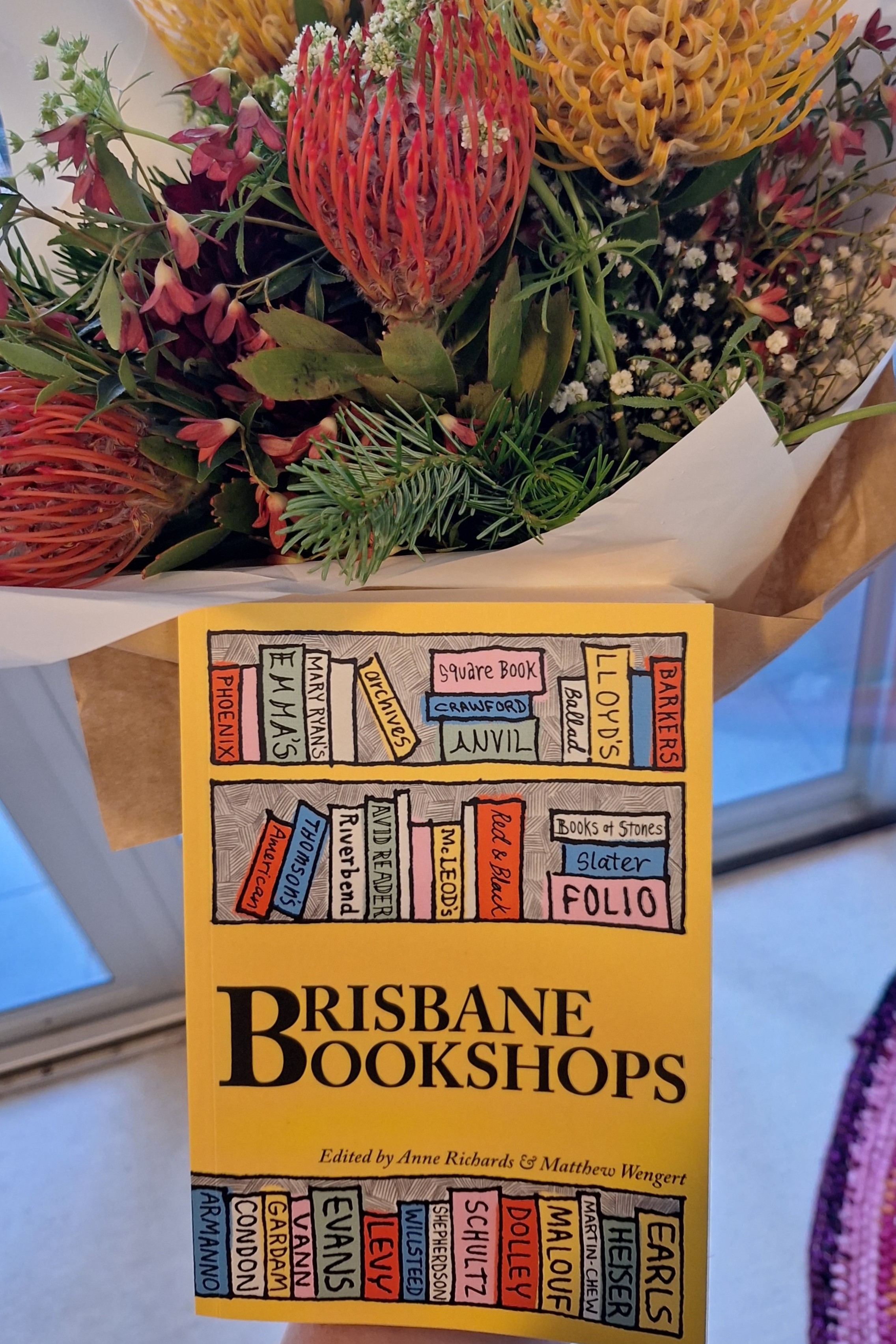
It is gratifying to see the printed copy of a manuscript, words finally set on the page of a physical book. The cover sang. The list of contributors read so well. I think this is the dynamic thing about the book that people emphasise in their comments. There is a diversity that is enticing, a history that’s enriching. The whole concept of creating a geography of Brisbane based around bookshops came to life through different voices.
What has been your favourite part of working on this project?
Matthew: Working with Anne, and later with Bianca, was a pleasure and a privilege – but my favourite aspect of developing this anthology was spending a lot of time, almost too much time, learning about some of the earliest or most important bookshops that served Brisbane readers over more than a century and a half. I was intrigued by the very early bookselling in the township, when it was the northern outpost of NSW. I was very interested in finding out about the railway book-stalls, and the notion of commuters browsing books and magazines on the way to and from work and shopping. After all, Penguin Books started with the idea of affordable books for railway travellers! And I was fascinated by the radical bookshops that were attacked, firstly by the federal security authorities, and later by neo-Nazis. Unfortunately, around 90% of the research has to be left behind when it comes to creating a readable book, but all that unused research was necessary and worthwhile to tell the whole story.
Bianca: My favourite part of this project was transcribing the interviews and using my creative writing skills to craft each interview into a profile telling a story of that bookshop. Finding and following each narrative thread, listening to first-hand accounts, and developing a keen ear for story has been equal parts surprising, delightful, and rewarding. Of course, transcribing by hand is a time-consuming process, so Anne helpfully put a few interviews through an AI program that transcribes voice-to-text, which meant I had a rough transcript to start with. This streamlined the process greatly, although I’d always listen back to the original interview recording and take my own notes. There is much to be gained from listening with the human ear that AI simply cannot match, in terms of tone and emotion, or even background noises that evoke a sense of place, such as cicadas and magpies!
I’ve learned so much from the whole experience, but perhaps the most unexpected lesson was on how to load and view a microfiche reel at the State Library. The week we were due to go to print, I was sent on a last-minute mission to hunt down a photo of the Red And Black Bookshop after it had been bombed in the early 1970s!
Anne: It was interesting watching the whole publishing process from the beginning, the germ of an idea leading on to the fabulous book launch at the State Library. One of the satisfying outcomes was in the decision to give the cover design to a young aspiring artist, Delilah Willsteed. Ideas were swapped, early designs teased out – and the final artwork so well executed. The book launch was a delightful event. A large crowd of welcoming, engaged, and happy people came together: booksellers, writers, researchers and readers. Thank you to Meg Vann and staff at SLQ Bookshop for enabling this event.
Where can people buy (or borrow) a copy of Brisbane Bookshops?
Matthew: Brisbane Bookshops is in most of the local independent bookshops: Avid Reader, Books@Stones, Museum of Brisbane Shop, Mary Ryans New Farm, Pulp Fiction, QAGOMA Store, Riverbend Books, State Library Shop, Scrumptious Reads, Shelf Lovers. Also Dymocks Indooroopilly. And also at andalsobooks.com. Copies are available for loan at the State Library, and in local council libraries.
Any final comments?
Anne: Brisbane has a rich history – often conflicted or dark, often tedious and seemingly boring. When we dig into that history, it becomes intriguing, surprisingly vibrant and embracing. The writers who contributed know this. Thank you.
Bianca: There is a wonderful sense of belonging and camaraderie that comes with working on any project with a shared purpose, especially when that project is a book, and that book contains a multitude of voices, and every single voice understands, supports, and celebrates their local bookselling community, and the arts more broadly. It is an ecosystem as far-reaching as it is deep and interconnected, and each aspect depends on the others. I would like to take this opportunity to thank Matthew and Anne, and also thank you to Backstreet Brisbane! The contribution each of you make to the arts is unique and invaluable.
Click here to find Brisbane Bookshops on the AndAlso website
 Backstreet Brisbane